How Do Automatic Dog Feeders Work?
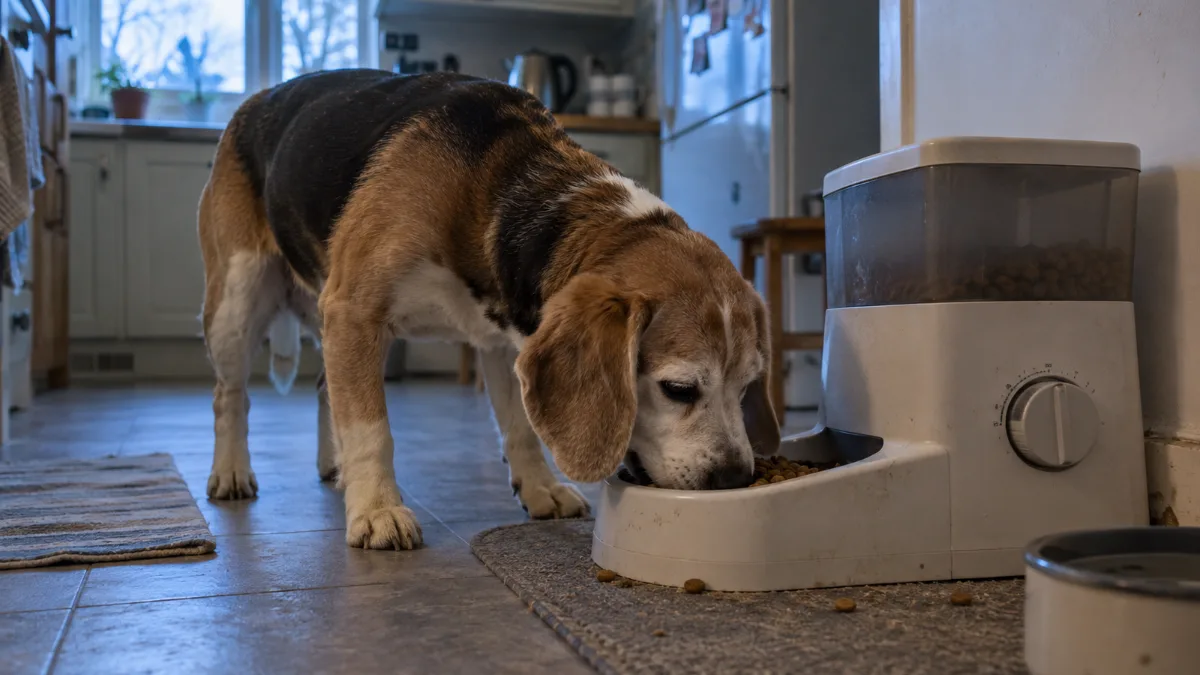
Underneath the app or LCD screen, most timed feeders use one of two basic mechanisms: a rotating disk or tray with pre-loaded compartments that turns to release one meal at a time, or an auger (a screw-like mechanism) that turns to move a measured amount of kibble from the hopper down a chute into the bowl. A built-in timer chip — controlled through onboard buttons, an LCD panel, or a phone app — tells the motor when to activate. Most units also include a battery backup (commonly D-cell batteries) alongside AC power, so a scheduled feeding still happens if the power goes out.
Types of Feeding Modes: Fixed Schedule vs. Interval vs. Portion-per-Meal
- Fixed schedule — you set specific times of day (say, 7am and 6pm) and the feeder dispenses a programmed portion at each one. This is the most common mode and suits most adult dogs on a normal two-meal routine.
- Interval feeding — instead of clock times, the feeder dispenses every set number of hours. This mode is more useful for puppies or dogs who do better with several small meals spread through the day rather than two larger ones.
- Portion-per-meal control — separate from timing, this is how much food gets released per feeding, usually set independently in cups or a rotating-disk compartment size. A time delay dog feeder or time release dog feeder is often a simpler version of this — a single delayed release rather than a full multi-meal schedule, useful for a one-off (like a delayed feeding while you’re out for the afternoon) rather than daily use.
A portion control dog feeder combines the two: you’re programming both when food comes out and how much, which is really what most people mean by “programmable” as opposed to a basic timed release dog feeder that only handles the schedule.
Programmable vs. Simple Timed: What’s the Difference
A simple time release dog feeder typically offers one or two fixed feeding slots with little or no portion adjustment — closer to a mechanical timer than a computer. A fully programmable automatic dog feeder allows multiple daily feedings, adjustable portions per feeding, and often app control with feeding history and notifications. If your dog is on a strict vet-recommended feeding schedule or you want to track whether feedings actually happened while you’re away, the programmable option is worth the extra cost; if you just want food to show up twice a day reliably, a simpler timed unit does the job for less. For a deeper comparison of WiFi, apps, alerts and remote controls, see our smart dog feeder guide.
If the goal is a scheduled snack rather than a meal, our timed treat dispenser guide separates app schedules from dog-pressed buttons.
What to Look for When Choosing a Programmable Dog Feeder
- Portion accuracy — cheaper mechanisms can under- or over-dispense by a noticeable amount meal to meal; reviews mentioning consistent portioning are worth more than the spec sheet alone
- Battery backup — a scheduled dog feeder that loses its schedule during a power outage defeats the purpose
- Manual override — a button to dispense an extra portion by hand, for when your dog’s schedule needs a one-off adjustment
- Voice or meal-call recording — lets you record a short message that plays at feeding time, useful for dogs used to being called to eat
- App vs. onboard controls only — an app adds remote scheduling changes and feeding confirmation, but also means more that can go wrong if your WiFi does
Timed Feeding for Specific Situations

PETLIBRO Granary 5 L — button version
Best for: Timed dry-food meals without an app.
- 5 L hopper
- button and display controls
- one to six scheduled meals daily

PetSafe Healthy Pet Simply Feed
Best for: Programmed meals on button controls for cats and small to medium-sized dogs.
- up to 12 meals a day, 1/8 to 4 cups per meal
- 24-cup hopper; dry or semi-moist kibble up to 3/4 inch
- runs on 4 × D batteries or an optional wall adapter (sold separately)

Whisker Feeder-Robot
Best for: Scheduled dry-food meals for dogs whose per-meal portion fits its dispenser.
- holds up to 32 cups of dry food without the hopper insert (25 cups with it)
- dispenses up to 1/2 cup per feeding in 1/8-cup steps, 1 to 8 times a day
- accepts dry or semi-moist kibble up to 5/8 inch

PETLIBRO Granary WiFi
Best for: Changing a dry-food schedule remotely from an app.
- up to 10 meals or snacks a day
- 5 L hopper
- app control with feeding logs
The mechanics above apply whether you have one dog or several, but a few situations change what else matters. If you’re feeding a large or giant breed, hopper capacity and kibble size become the bigger constraint than timing itself — see our automatic dog feeder for large dogs guide for that. Feeding multiple dogs or a kennel setup raises fairness and portion-separation issues that a single timed hopper doesn’t solve on its own — that’s also covered in the large-dogs guide’s multi-dog section. For the full model comparison across use cases, see our dog feeders hub.
Frequently Asked Questions
What’s the difference between a timed feeder and a programmable feeder?
In practice the terms overlap, but “timed” often implies a simpler, one-or-two-slot schedule, while “programmable” implies more flexibility — multiple daily feedings, adjustable portions, sometimes app control.
Will a timed dog feeder still work if the power goes out?
Most models include battery backup specifically for this — check that a unit has one before buying if reliability during outages matters to you, since not every budget model includes it.