
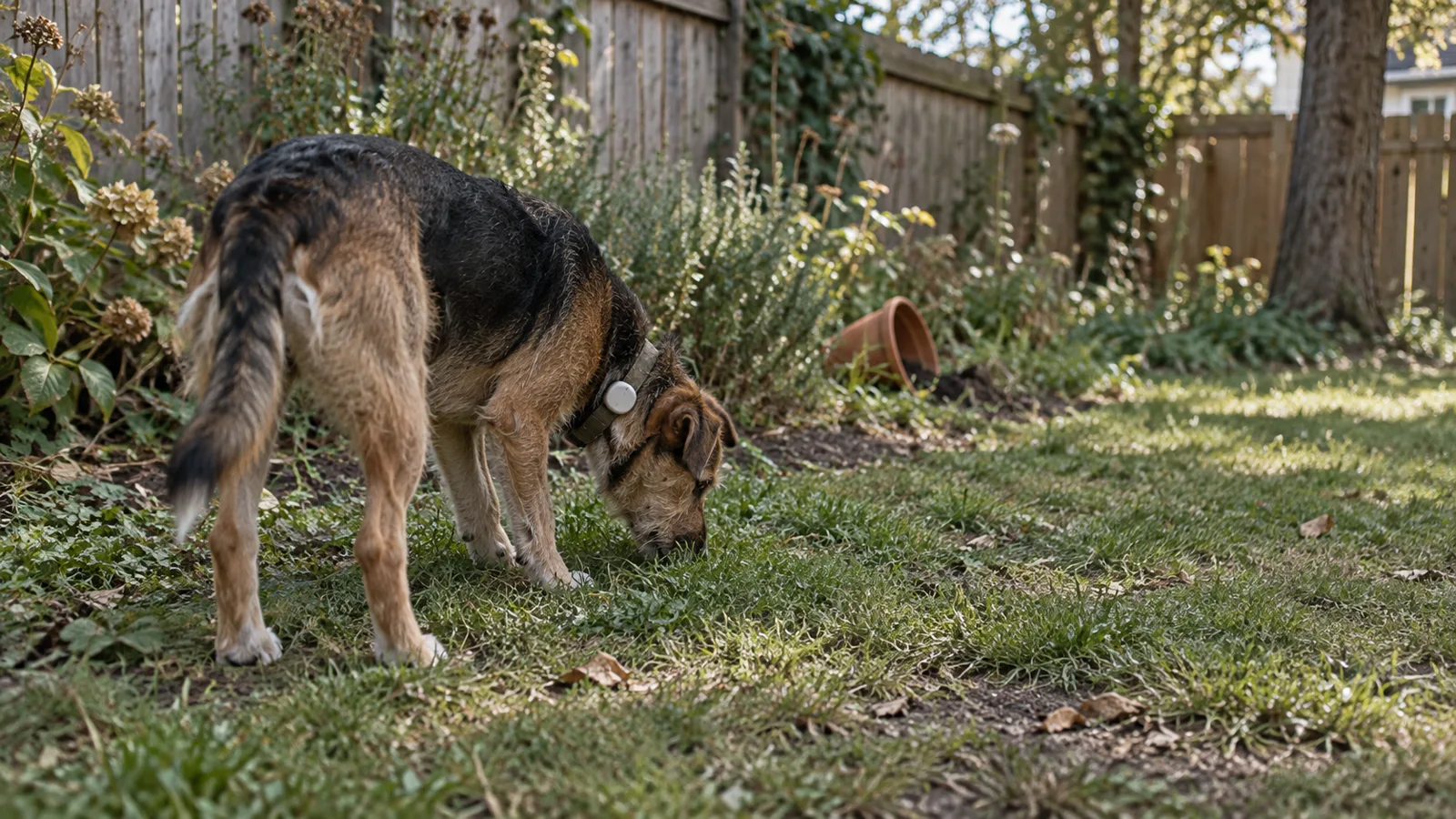
“GPS collar” covers three products that behave very differently once the pet leaves the yard. All of them use satellite positioning to work out where the pet is. They differ in how the location travels to you, whether the device can also act as a boundary, how long the battery lasts between charges, and whether there is a bill every month. This hub explains those differences using the makers’ own published figures, points you to the two detailed guides, and lists the documented models we have checked. BowlScout reads specifications; it does not field-test trackers, and it does not evaluate any health or behaviour feature medically — see the methodology page.
Three Ways a Collar Reports a Position
| Type | How the location reaches you | Ongoing plan | Typical battery claim | Examples checked |
|---|---|---|---|---|
| Cellular GPS tracker | Over LTE / LTE-M to the maker’s servers, then to your app | Required (the device has a SIM) | Days to weeks; Fi claims up to 3 months | Fi Series 3+, Tractive DOG 6 / CAT 6 Mini |
| GPS fence collar | Cellular for the app, GPS for the boundary; the collar itself gives feedback at the fence line | Required | Halo Collar 5: up to 48 hours (maker claim) | Halo Collar 5 |
| Radio GPS tracker | By VHF radio to a handheld receiver you carry | None; a compatible handheld is a separate purchase | Garmin: up to 68 hours, 136 with an extended pack | Garmin Alpha T 20 |
| Bluetooth tag (not GPS) | By Bluetooth to nearby phones | None | Months on a coin cell | Not covered here |
The radio path dictates almost everything else. A cellular tracker works wherever its network partner has coverage and nowhere else; Tractive states it works in 175+ countries, and Fi’s collar page does not publish a coverage map. A radio tracker works wherever you and the dog are within range of each other — Garmin lists up to 9 miles for the Alpha T 20 — regardless of cell coverage, which is the use case Garmin’s own announcement describes (sporting dogs, hunting). A GPS fence is a cellular tracker with a job: it defines a boundary and uses sound, vibration or static feedback when the dog reaches it.
How to Read a Tracker Spec Sheet
Minimum pet weight
Makers state a floor, and it is about the device’s weight and bulk relative to the animal, not about accuracy. Tractive lists the DOG 6 for dogs above 4 kg, the DOG 6 XL for dogs above 20 kg, and the CAT 6 Mini for cats 3–8 kg, per tractive.com. Halo lists its collar for dogs over 5 months old and over 10 lb with an 8″–30.5″ neck, per halocollar.com. Fi describes a modular design for XS to XL dogs on fitracking.com without a weight floor on that page.
Battery claims and the conditions attached
Every battery figure has a condition. Tractive publishes two numbers per device: up to 6 days for the DOG 6, or up to 2 weeks with Power Saving Zones (places where the tracker uses Wi-Fi or Bluetooth instead of GPS). Fi claims up to 3 months on its collar page without stating the conditions there. Halo’s up-to-48-hour claim for Collar 5 covers AlwaysOn GPS tracking while the collar also enforces a fence. Garmin’s 68 hours assumes Dynamic Tracking slowing updates when the dog stops. Compare numbers under the same condition, and expect live-tracking mode to drain any of them far faster.
Waterproof rating
IP68 (Tractive, Fi) means sustained immersion to a depth the maker specifies; Fi adds IP66K and states fresh and salt water to 50 metres. IP67 (Halo) means temporary immersion to about a metre. Garmin uses a 1 ATM rating, equivalent to 10 metres of static pressure. A dog that swims daily belongs in the first group.
Subscription terms
A cellular tracker without an active plan is a weight on the collar. Fi’s support pages state that an active membership is required to use GPS tracking, activity monitoring and escape alerts. Tractive’s subscription covers the built-in SIM and is chosen at activation. Halo says a Pack Membership plan is required for every collar. Plan lengths and prices change; our subscription guide explains what to compare, and the calculator lets you enter the current figures yourself.
Documented Models by Type
Halo Collar 5 is the current fence-collar option here. Pack Membership is required; check the selected Midnight listing and plan separately. Check Halo Collar 5 on Amazon

Fi Series 3+ Smart Collar
Best for: Dogs that wear a collar 24/7 and owners who want the longest stated battery life in this set.
- Fi states “up to 3 months of battery” and IP68 + IP66K rating “in fresh and saltwater up to 50 meters”
- modular design “fit for XS to XL dogs”; stainless-steel frame; LED lights; wireless charging
- an active Fi Membership is required to use GPS, activity monitoring and escape alerts

Tractive GPS DOG 6
Best for: A light clip-on tracker for dogs above 4 kg that travel with you.
- 39 g, 71 × 29 × 17 mm; “100% waterproof (IP68)”; recommended for dogs “above 4 kg”
- battery “up to 6 days”, or up to 14 days with Power Saving Zones set
- LTE/4G (Cat1bis), Bluetooth 5.0 and 2.4 GHz Wi-Fi; a Tractive subscription covers the built-in SIM

Tractive GPS CAT 6 Mini
Best for: Cats 3–8 kg; the collar is integrated with a safety release and LEDs.
- 32 g including the collar; 95 × 20 × 13 mm; IP68; Tractive lists cats “3-8 kg”
- “Tracker-integrated collar with safety release & LEDs”
- battery “up to 4 days”, or “up to 7 days” with Power Saving Zones; subscription required

Garmin Alpha T 20
Best for: Off-grid tracking with a Garmin handheld (sold separately) instead of a cellular plan.
- VHF radio range “up to 14.48 km (9 mi.)” to a compatible Garmin handheld (Alpha 10/100/200/200i/300/300i, Astro 430, PRO 550 Plus)
- battery “up to 68 hr.” standard, “up to 136 hr.” with the extended battery box; 1 ATM water rating
- Dynamic Tracking slows GPS updates when the dog is stopped; seven-colour LED beacon; no cellular plan is part of the system
For the three-way spec table, read Fi Series 3+ vs Tractive vs Halo.
Activity, Sleep and “Health” Features
Fi, Tractive and Halo all describe activity and sleep tracking, and Fi and Tractive go further: Fi lists AI-powered detection of behaviours such as scratching, licking and barking, and Tractive lists heart and respiratory rate monitoring. We report those as the manufacturers describe them. BowlScout does not assess whether any of it is medically meaningful, and nothing in these guides is veterinary advice. If a tracker’s graph makes you wonder about your pet, the person to ask is your veterinarian.
Cats Are a Separate Problem
A cat tracker has to be light enough for a cat and attached to a collar that releases if it snags. Tractive’s CAT 6 Mini is 32 g including an integrated collar with a safety release and LEDs, for cats 3–8 kg, with a 4-day claim (7 with Power Saving Zones). Fi and Halo are dog products. If your cat is under 3 kg, none of the cellular trackers we checked lists it as suitable; a Bluetooth tag, which is not GPS, may be the only documented option.
What a GPS Fence Is and Is Not
Halo’s collar defines a boundary in the app and gives the dog feedback as it approaches: six types in Halo’s description, delivered as sounds, vibrations or static. It needs the same training commitment as any boundary system, and Halo’s own minimums — over 5 months and over 10 lb — reflect that. A fence collar is not a containment guarantee, and a tracker is not a fence: Fi and Tractive alert you after the dog leaves a zone, they do not act on the dog.
Quick Checklist Before You Buy
- You have chosen the radio path: cellular (plan required), radio to a handheld (no plan, handheld required), or a fence collar (plan required)
- Your pet is above the maker’s minimum weight and, for Halo, the minimum age
- You compared battery claims under the same condition (standard vs power-saving)
- The waterproof rating matches how your pet meets water
- You have read the plan terms on the maker’s site and, for cellular devices, confirmed coverage where you live and travel
- For cats: the collar has a documented safety release
- You have noted the trial or return window (Fi, Tractive and Halo each publish one) before activating a plan
Frequently Asked Questions
Do all GPS collars need a subscription?
Cellular trackers and GPS fence collars do: Fi, Tractive and Halo all state a required plan. Radio trackers such as Garmin’s Alpha T 20 do not have a plan but need a compatible Garmin handheld. Bluetooth tags have no plan and no GPS.
How accurate are they?
Makers publish their own figures — Halo states accuracy within two feet with its Precision+ GPS — and we quote rather than verify them. Any GPS device loses accuracy indoors and under dense cover.
Can I use one tracker for two pets?
Each tracker locates one animal. Makers that require plans require one per device: Halo states “a plan is required for each collar”, and Fi’s support site carries an article on one subscription per collar.
Is a GPS collar a substitute for a microchip?
No. A microchip is passive identification read by a scanner; a GPS collar is an active device that can come off, run flat or lose signal. Makers present them as complements.