
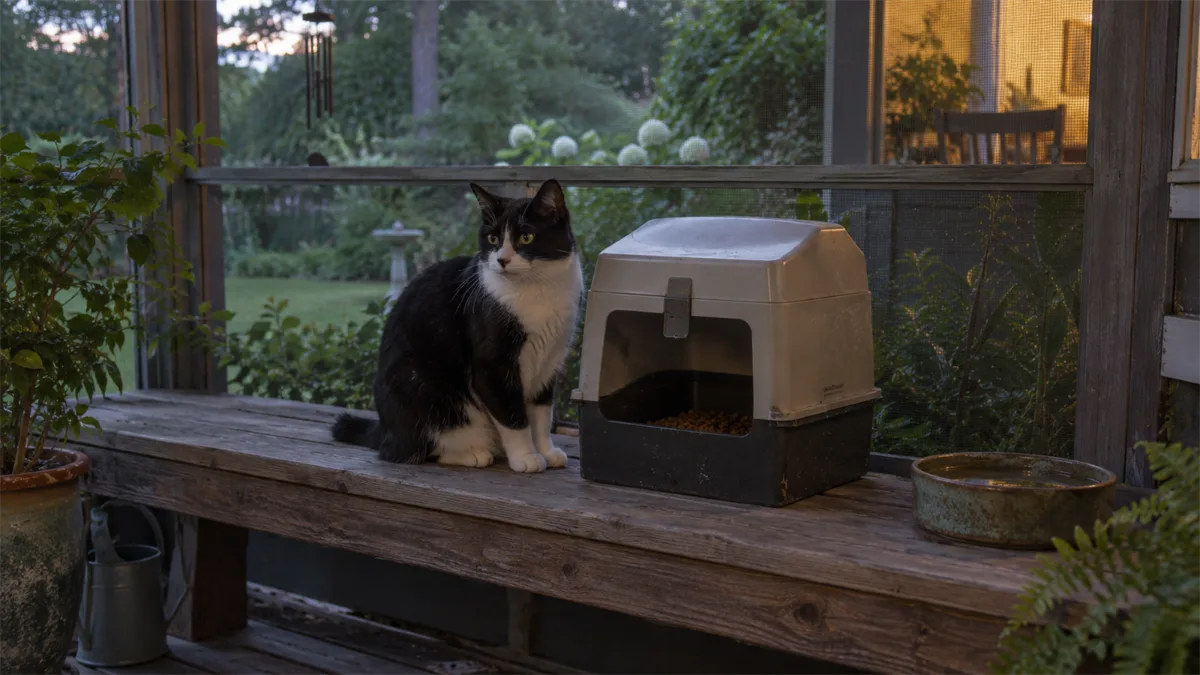
How Raccoon-Resistant Feeders Actually Work
Three features do most of the real work in a raccoon proof automatic cat feeder. Timed, programmed dispensing means food only becomes available during hours you set — since raccoons are mostly nocturnal, scheduling meals for daytime removes the food-access window during the hours a raccoon is actually active, without needing any physical barrier at all. A sturdy, snap-locking hopper lid adds a genuine physical barrier on top of that, keeping the bulk food supply sealed between dispensing cycles. And RFID or microchip-restricted feeders — which only unlock for a specific cat’s chip or collar tag — go a step further by controlling who can trigger the mechanism in the first place; see our RFID and chip-controlled feeder guide for how that actually works. None of these three approaches requires the others, but layering timed access with a locking lid is a reasonable, achievable combination for most outdoor setups.
Can a Raccoon Actually Defeat a “Raccoon-Proof” Feeder?
Sometimes, yes — and it’s worth knowing that going in rather than assuming a locking lid settles the question permanently. Real product reviews note that some detachable feeder components will simply come off if a raccoon applies enough sustained force, even on models marketed with raccoon-resistant features. Raccoons are also physically capable, patient, and willing to keep working at something over multiple nights, which is a different kind of pressure than a snap lock is usually tested against. None of this means the features above aren’t worth having — they meaningfully reduce casual access — but treat “raccoon-resistant” as the honest description rather than “raccoon-proof,” and consider bringing feeders in overnight or securing them to a fixed surface if raccoon pressure in your area is heavy.
Ants Are the Other Outdoor Pest Problem
An automatic cat feeder ant proof enough to actually stop ants outdoors needs a different set of fixes than the raccoon problem, since ants are attracted to residual food scent rather than trying to force a lid open. A few approaches work in combination: a food-grade gel barrier (sold as an ant-blocker or antblocker automatic cat feeder accessory) applied to the feet the unit stands on creates a physical barrier ants won’t cross, and unlike petroleum jelly it doesn’t melt and need reapplying in outdoor heat. A sealed hopper with a tight-fitting lid and, ideally, a desiccant pack reduces the food scent that draws ants toward the storage bin in the first place — though this only protects the bin, not the exposed bowl once food is dispensed. Scheduling smaller, more frequent meals rather than leaving a full bowl out all day also shrinks the window ants have to find it. Water-moat barriers, the classic ant solution for a manual bowl, generally aren’t practical for an electric automatic feeder, since the unit can’t safely sit in standing water. Realistically, no single method fully solves ant access on its own — a gel barrier tray, a sealed hopper, and a reasonable feeding schedule layered together is the practical outdoor answer.
Best Raccoon-Resistant Cat Feeders
- Best for chip-restricted access: An RFID or microchip feeder like SureFeed — controls which animal can open the feeder at all rather than relying on a lid alone; see the RFID guide for real limitations worth knowing (it restricts access, not necessarily physical force from a determined raccoon).
- Best for a locking hopper: A feeder with a sturdy snap-lock hopper lid. Check whether the maker rates it for outdoor use at all; a lid alone may not stop a determined raccoon, so pair it with a fixed, weighted placement in a sheltered spot rather than relying on the lock alone. Our outdoor cat feeder guide covers what makers rate for outdoor use.
- Best for scheduling around raccoon hours: Any genuinely programmable feeder set to dispense only during daylight — see our timed cat feeder guide for how scheduling modes actually work.

SureFeed Microchip Pet Feeder
Best for: Limiting bowl access to registered cats. It controls access; it is not a force-resistance rating.
- lid opens for a registered microchip or SureFlap RFID collar tag (one tag included) and stays closed for unregistered animals
- sealed 400 ml bowl for wet or dry food
- 4 × C batteries; maker cites about 6 months of battery life

Cat Mate C3000 Automatic Dry Food Feeder
Best for: Programming dry-food meals for daytime hours only.
- digital timer for up to three meals a day
- holds up to 6.5 lb of dry food
- maker lists it for cats and dogs
Quick Checklist Before You Buy
- Program feeding times for daytime hours if raccoons are active in your area at night
- Look for a snap-locking hopper lid, and secure the unit to a fixed surface if raccoon pressure is heavy
- Add a gel-based ant barrier to the feet, not petroleum jelly, for outdoor durability
- Choose a sealed hopper with a tight lid to reduce food scent between meals
- Don’t expect any single feature to be a complete guarantee against either pest — combine two or three approaches
Frequently Asked Questions
Is any cat feeder actually 100% raccoon proof?
No — treat “raccoon-resistant” as the accurate description. Timed access, locking lids, and chip-restricted feeding all meaningfully reduce the odds of a raccoon getting in, but a sufficiently determined raccoon can sometimes still force open or detach parts of even a well-designed feeder.
What’s an antblocker automatic cat feeder accessory?
It’s typically a gel-based physical barrier applied to the feet or base a feeder stands on, creating a surface ants won’t cross to reach the food above. It’s an add-on approach rather than a feature built into most feeders themselves.
Should I bring my outdoor cat feeder in at night?
If raccoon activity is heavy in your area, bringing the feeder in overnight (or scheduling all meals for daytime) removes the food-access window entirely during the hours raccoons are most active — a simpler fix than relying on any lock to hold up indefinitely.