
“Large cat” can mean a long-bodied Maine Coon that is not especially heavy, a compact but heavy mixed-breed cat, or a cat that simply refuses an enclosed box. Those are different shopping problems. The weight range tells you whether the sensors and mechanism are specified for the animal; the opening and interior tell you whether the animal can use the box comfortably. No published number proves that a particular cat will accept it. If you can, keep the old box during a supervised transition and see how your cat approaches the new one.
We use three products already covered in BowlScout’s self-cleaning litter box hub. They represent a rotating globe, an open-top sifter and a water-connected washer. We did not invent a score for odor, noise, reliability or “cat approval.” The existing fit-check tool can screen maker weight and floor-space limits, but it cannot know your cat’s posture or habits. Use this article to understand the trade-offs before you run the tool.
Two separate fit checks: weight and body geometry
Every device that starts a cleaning cycle when a cat leaves needs some way to detect the animal. A maker’s minimum weight can matter as much as its maximum. Whisker states Litter-Robot 4 for cats from 3 to 25 lb. Neakasa’s M1 Plus page states 2.2 lb to around 33 lb. CatGenie’s A.I. pages describe a different washer mechanism and provide conflicting descriptions of upper-weight comfort and recommended multi-cat use; check that point with CatGenie for a cat near the high end. Do not convert a maximum into a guarantee that a big cat can turn around inside.
Then measure the doorway and usable interior. Whisker gives Litter-Robot 4 a 15.75 × 15.75 inch entryway and 16.5 inch interior height. Neakasa publishes an open top and an entry height rather than an enclosed doorway. CatGenie is an open bowl, but its full assembled footprint includes water and drainage hoses. A cat that backs out of a covered tray may prefer open access, but the product sheet does not prove behavior. A cat’s length from nose to tail tip is not its required turning diameter either; watch how it stands and turns in its current box.
The published dimensions are most useful as rejection filters. A 28 lb cat exceeds Whisker’s stated Litter-Robot 4 upper bound and fits Neakasa’s stated range, subject to the M1 Plus’s actual physical fit. A 20 lb cat is inside both ranges but could still dislike a globe’s interior. A kitten below a maker’s minimum may not be reliably detected, so automatic cycling must follow that maker’s instructions. In multi-cat homes, every cat using the device must fit, not just the largest one.
Compare the documented candidates
| Model | Weight statement | Entry and mechanism | Litter and waste | Practical limit |
|---|---|---|---|---|
| Whisker Litter-Robot 4 | 3–25 lb | Rotating globe; 15.75 × 15.75 in entry; 16.5 in interior height | Compatible clumping litter; waste drawer | Check both upper weight and turning room. |
| Neakasa M1 Plus | 2.2 to around 33 lb | Open-top sifter; maker lists entry height separately | Maker-approved clumping litter; waste bag/drawer system | Wider weight range does not guarantee every large cat accepts it. |
| CatGenie A.I. | Maker’s overview lists up to 25 lb; FAQ emphasizes best multi-cat success at or below 20 lb each | Open water-connected washer; assembled footprint 19.25 × 24.5 × 21 in | CatGenie washable granules; drains waste to plumbing | Needs water, drain and power; clarify weight wording for your household. |
Sources: Litter-Robot 4 maker specifications, Neakasa M1 Plus maker specifications, CatGenie A.I. overview and CatGenie FAQ, read 2026-10-12. Whisker’s stated entry and interior measurements are product dimensions, not our measurements. The CatGenie row deliberately preserves the difference between its overview and FAQ instead of silently choosing the larger number.
Three candidates, each with a reason to buy or pass

Whisker Litter-Robot 4
Best for: a cat inside Whisker’s 3–25 lb range whose body fits the published entry and interior. Rotating globe with a waste drawer.
Skip if: your cat exceeds 25 lb or will not enter an enclosed globe.

Neakasa M1 Plus — Entrance Litter Guard bundle
Open-top self-cleaning litter box. Neakasa states a 2.2 lb to around 33 lb range, a 13.86-inch entry and an 11.23 L waste bin. The Plus revision uses six infrared sensor arrays. This Amazon offer includes the entrance litter guard; confirm the selected bundle and accessories.
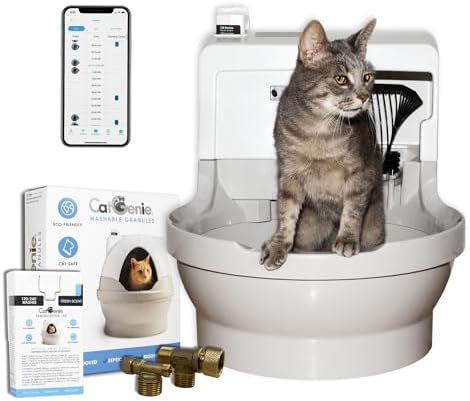
CatGenie A.I.
Best for: a suitable cat and a home with a feasible water and drain connection; no waste drawer to empty.
Skip if: plumbing is unavailable, or your cat is near a disputed maker weight statement until CatGenie confirms fit.
Neakasa references on this page now cover M1 Plus. Its exact Amazon offer is the Entrance Litter Guard bundle. Litter-Robot 5 remains an editorial comparison with manufacturer sources; no exact Amazon listing was established, so it has no purchase card. Litter-Robot 4 remains a separate option within its own 3–25 lb range and up-to-four-cat limit.
Litter-Robot 4: a globe with a published entry
Whisker’s strongest advantage for this comparison is that it publishes both a weight range and opening geometry. A buyer can check 3–25 lb against the actual cat, then compare 15.75 × 15.75 inches and 16.5 inches of interior height with how the cat uses its current tray. Litter-Robot 4 is already one of the detailed products in BowlScout’s three-model comparison. That page also explains why a raking crystal tray is a different mechanism, not simply a cheaper globe.
Who it is for: a large cat still within the 25 lb published limit and tolerant of an enclosed entry, where the household wants a drawer rather than a drain connection. Who should skip: a cat above that limit or one consistently avoiding covered trays. A 24 lb cat is inside the weight spec but close enough to the upper boundary that physical stance and ease of turning deserve extra attention. The maker’s stated range is not a recommendation to force a reluctant cat into a new box.
Neakasa M1 Plus: the open-top alternative
Neakasa lists the M1 Plus for cats from 2.2 lb to around 33 lb. That is the broadest stated range among these three products. The open top removes the enclosed globe doorway, and the maker publishes an entry height rather than an interior headroom dimension. Open access may be easier to approach for a cat that dislikes covered boxes, but there is no reason to claim a behavioral win from the product sheet. Observe your cat with a conventional open tray before treating this as a solution.
Who it is for: a cat over Litter-Robot 4’s stated maximum, or a long-bodied cat for whom an open-top layout is preferable, provided the Neakasa weight and floor-space constraints are met. Who should skip: a buyer without room for its footprint or expecting the larger upper limit to mean maintenance-free operation. Check how the waste bag is replaced and which litter the exact M1 Plus variant accepts. If more than one cat uses the box, the multi-cat capacity guide covers drawer turnover as a separate limit.
CatGenie A.I.: an open bowl with installation work
CatGenie’s A.I. does not store clumps in a drawer. It uses its specified washable granules and a water/drain connection to process waste, so its maintenance and installation questions differ from both sifting models. The maker’s overview lists a cat weight limit up to 25 lb. Its FAQ says its most consistent result in a two-cat home is with cats up to 20 lb each, while other FAQ wording describes no absolute weight prohibition. We cannot reconcile those statements from the pages alone; ask CatGenie about a particular heavy cat before choosing it.
Who it is for: a household that can supply the required plumbing and wants an open bowl without a routine drawer-emptying step. Who should skip: renters or rooms without appropriate water and drainage, or a buyer expecting ordinary clumping litter to work. The A.I. uses its own washable granules; confusing it with the newer Whoosh model’s litter rules would be a costly version mistake. Check the precise A.I. manual and supported supplies.
Measure before you trust a breed label
- Record each cat’s current weight. Use the most recent reliable number and allow for change. A “large breed” label without a weight cannot be compared with a sensor range.
- Watch current box behavior. Does the cat stand with its head outside? Turn in place? Avoid a lid? Take a short note rather than guessing from body length alone.
- Measure the installation area. Include room for the lid or waste drawer to open, for your hands to clean the device, and for any water and drain hose. The printed exterior dimensions are only the start.
- Check the lightest cat too. In a household with a kitten, the maker’s minimum detection weight and kitten mode affect when automatic cycling is appropriate. Keep a conventional box available as instructed.
- Confirm litter and power. An open or enclosed box can still reject a litter type. Check the exact model’s allowed litter, power supply and manual before introducing it to the cat.
Run the BowlScout fit check with your cat’s weight and available floor space. It screens documented limits; it cannot assess posture, comfort, sensor behavior in your home or whether the cat will adapt. If two cats use one box, capacity and drawer servicing become a separate decision. A maker’s “up to four cats” statement is not a promise of four times the drawer interval.
What this shortlist deliberately does not infer
We do not call any of these the quietest, cleanest or most reliable. That would require controlled testing under comparable litter, cat and maintenance conditions. Decibel claims from different makers are not automatically comparable. We also do not use an app’s weight history as a medical measure. The weight ranges here describe operation of a litter box, not a diagnosis or a target weight for a cat.
We did not include PetSafe ScoopFree Crystal Smart as a large-cat pick because the current maker material we checked does not publish a comparable upper cat-weight range. It remains a valid product in BowlScout’s general litter box guide; it simply cannot pass this weight-first shortlist on a guessed number. This is what “not stated” should do in a buying guide: stop an unsupported recommendation, not invite the writer to fill the gap.
For cats near the upper end of any range, confirm the current manual and model revision before buying. For CatGenie A.I., seek a direct explanation of the differing weight language. If a maker changes a spec, BowlScout’s methodology explains how the source date is recorded and updated.
Frequently Asked Questions
What is the highest published weight range among these three?
Neakasa states 2.2 lb to around 33 lb for the M1 Plus. That does not prove physical comfort or acceptance for every cat near 33 lb.
Will a 28 lb cat fit Litter-Robot 4?
Whisker lists Litter-Robot 4 for cats up to 25 lb, so 28 lb is outside its stated range. Consider only models whose maker range includes your cat and verify physical fit separately.
Does an open-top box automatically suit every large cat?
No. Open access removes an enclosed doorway, but floor space, entry height, litter and individual behavior still matter. Introduce a new device with a backup box available.
Is CatGenie A.I. suitable for a cat above 20 lb?
Its overview lists up to 25 lb, while its FAQ emphasizes best multi-cat success at or below 20 lb each and uses other broad wording. Ask CatGenie to confirm your cat and household against the exact A.I. version.
Can I use ordinary clumping litter in CatGenie A.I.?
No. CatGenie’s A.I. instructions specify its washable granules and a water/drain setup. Do not transfer litter advice from a different CatGenie model.
Method and source dates
We started with self-cleaning models already documented on BowlScout and kept three that represent distinct large-cat fit paths. We checked maker weight, entry, mechanism and installation statements on 2026-10-12: Litter-Robot 4 maker specifications, Neakasa M1 Plus maker specifications, CatGenie A.I. overview and CatGenie FAQ. Where CatGenie’s wording conflicts, the conflict is shown. No physical cat, odor, noise or cycle test was performed, and no price, rating or review is used to rank the candidates.