
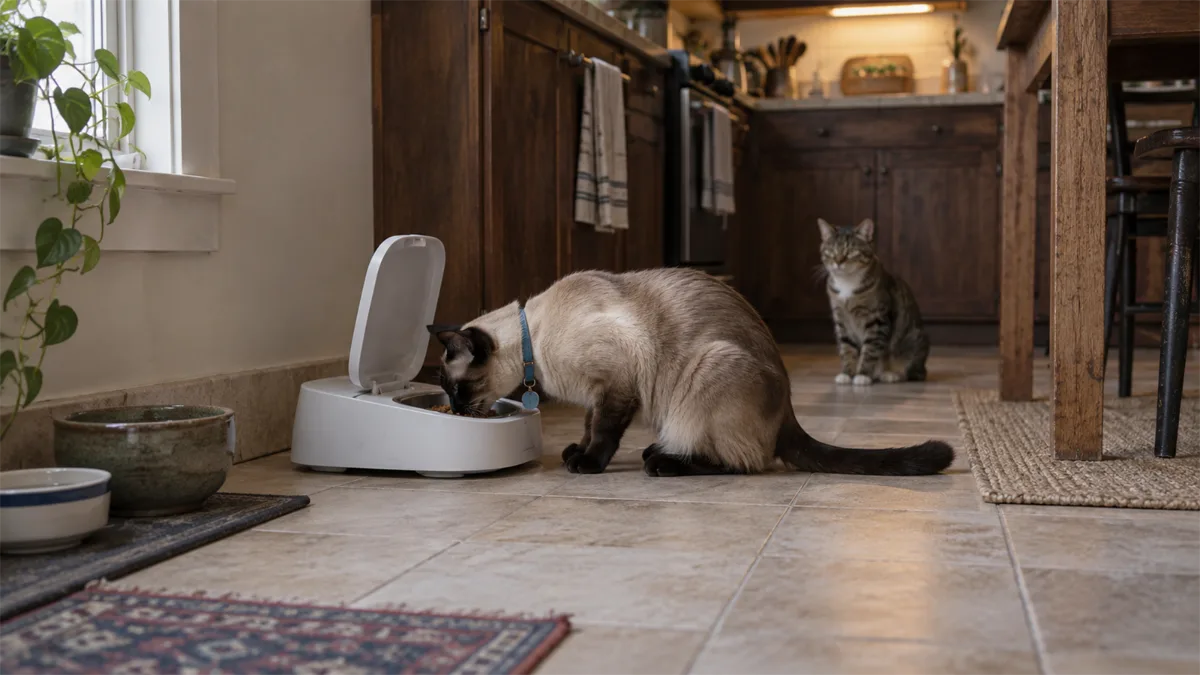
Microchip vs. Collar Tag: What’s the Difference
An RFID automatic cat feeder generally works one of two ways. A microchip cat feeder (an automatic cat feeder with chip reader) reads the same implanted microchip your vet uses for identification — no extra gear needed, since almost any cat already has one if they’ve been chipped. A collar-controlled cat feeder instead reads a separate RFID collar tag, which is easier to move between cats or replace if lost, but only works as long as the collar stays on — a real consideration if your cat is a collar-shedder. Some feeders, including well-known models like SureFeed, are actually compatible with both a microchip and a collar sensor cat bowl setup in the same unit, so you’re not necessarily locked into one approach when you buy. Whichever you pick, the mechanism behind a chip controlled cat feeder or chip operated cat feeder is the same: tag or chip, reader, and a lid that only opens for an authorized signal — not a fundamentally different technology depending on which one you choose.
Sensor Lid: How It Actually Works
A sensor-lid feeder built around this technology works in three steps: the reader detects an approaching cat’s tag or chip, the covered bowl unlocks and opens, and it closes again once that cat walks away. Covered cat feeders using this mechanism keep food fresher and pests out between meals as a side benefit of the access control. One honest thing worth knowing: how fast the lid closes after the authorized cat leaves matters more than it sounds like it would — a slow-closing motion sensor cat food bowl can give a second, unauthorized cat just enough time to sneak in before it locks, especially if that cat has learned to wait nearby for the moment.
Keeping the Dog Out
If you have a dog as well as cats, a cat food dispenser dog proof setup needs more thought than the chip-lock mechanism alone provides. The sensor lid controls who the feeder dispenses food for, but it doesn’t necessarily stop a larger or stronger animal from physically getting at or tipping the unit over — a dog is generally not going to trigger the chip reader, but a determined dog can still knock a lightweight feeder around or push it out of position. This is common enough that dog-proof cabinet or enclosure accessories exist specifically to physically block a dog from reaching a chip-locked cat feeder while still letting the right cat in. If dogs are a real factor in your household, see our automatic dog feeder guides for the other side of a mixed-pet setup, and consider pairing a chip-locked feeder with a physical barrier rather than relying on the sensor alone.
Keeping Out a Second Cat
A cat proof automatic feeder generally does a good job of restricting access to food, but real owner reports are worth knowing before you assume it’s foolproof against another cat in the house. A persistent or food-motivated second cat can sometimes reach around the back or side of the unit if it’s not placed flush against a wall, or push the authorized cat out of the way physically even though the lid opened for the right one. Positioning the feeder against a wall (some owners add a rear cover for exactly this reason) and choosing a model with a fast-closing lid meaningfully reduces this risk, even if no locked cat feeder is completely immune to a determined housemate.
Tamper-Proof: Can My Cat Get In on Its Own?
A tamper proof cat feeder is designed to resist a cat simply pawing, nudging, or dragging it open, but “tamper proof” is a relative term here, not an absolute one. Real owner reports include cats dragging an entire feeder away from a wall to work around it, and it’s worth choosing a heavier unit or one designed to sit low and stable if your specific cat is the persistent, mechanically curious type. Battery-powered units (commonly four C batteries, often good for something like 6–12 months) also depend on that battery staying charged — a tamper proof automatic cat feeder that’s slowly losing power can become easier to defeat well before the batteries are visibly dead.
Best RFID Cat Feeders
Choose access control and meal scheduling separately. These models address different needs; a lid that recognises one pet does not guarantee that another animal cannot reach the bowl.
| Model | Access and food | Scheduling / power | Who it suits / limitation |
|---|---|---|---|
| PETLIBRO One PLAF301 | One paired proprietary collar tag; not an implanted microchip. Dry kibble; 3 L (~13 cups). | App-scheduled dispensing; corded power + 3 alkaline D backup batteries. | A single tagged pet needing scheduled dry meals. Battery mode loses internet functions; a blocked lid can fail to close, so supervise adaptation. |
| SureFeed Microchip Pet Feeder | Compatible implanted microchip or Sure Petcare tag; wet or dry food. | Manually filled access-controlled bowl, rather than scheduled dispensing; 4 C batteries. | Separating diets when a collar is unsuitable. It does not meter scheduled meals; rear access and physical interference still need attention. |
| SureFeed Microchip Pet Feeder Connect | Microchip/tag access; wet or dry food. | Manual filling with scales and app feeding records; the app requires a separate compatible Hub. | Diet separation with intake monitoring. Check whether the listing includes the Hub; portion guidance is not automatic meal dispensing. |
Decisive sources: PETLIBRO PLAF301 specifications, tag, battery and lid limitations, SureFeed manual, and SureFeed Connect / Hub requirements. Specifications checked September 14, 2026 against US-facing manufacturer/support material. Confirm the exact model and package at the retailer; this is a document review, not hands-on testing.

SureFeed Microchip Pet Feeder
Reads a compatible implanted microchip or collar tag.

PETLIBRO One RFID
Collar-tag access with app-based feeding controls.

SureFeed Microchip Pet Feeder Connect
Connected model; confirm that the required hub is included or purchased separately.
- Best overall / dual compatibility: A model like the SureFeed Microchip Pet Feeder, which reads both an existing microchip and an RFID collar tag in the same unit — genuinely flexible, though it’s worth knowing going in that it controls access rather than portion size, so it won’t stop an authorized cat from overeating once the lid opens.
✓ Pros
- Reads both an existing microchip and an RFID collar tag in the same unit — genuinely flexible
- Works with wet or dry food
- 3-year warranty available
✕ Cons
- Controls access, not portion size — won’t stop an authorized cat from overeating once the lid opens
- Small ~1.6-cup capacity means daily refills
- Not programmable for scheduled meal times
Price: Check the current feeder price — this standard model works on its own; only the Connect version needs the separate Hub
- Scheduled collar-tag option: The PetLibro One RFID Cat Feeder, the PLAF301 dry-food feeder with a 3 L (~13-cup) hopper, corded power and backup from three alkaline D batteries; compare its dimensions with your available space.
✓ Pros
- Corded power with backup from three alkaline D batteries; batteries are not rechargeable or included
- Dual-band WiFi (2.4GHz + 5GHz) with app-based diet tracking
- 24-month warranty and 30-day money-back guarantee
✕ Cons
- Reads a collar tag only, not an implanted microchip
- One feeder + one collar per cat — multi-cat homes need a separate unit for each pet
- Dry food only; 3 L (~13-cup) hopper
Price: Check the current PLAF301 listing price
- Best for two cats specifically: A paired RFID cat feeder set built for multi-cat, different-diet households — sold as a matched pair so each cat gets consistently restricted access to their own food, useful for anti-stealing and diet separation at once. See our multiple cats guide for how this compares to a simple dual-bowl (non-restricted) feeder.
As with any best rfid cat feeder list, check whether the model offers portion control in addition to access control — many don’t — and read recent owner reviews on sensor reliability before buying, since chip-reading consistency varies more between models than the spec sheets suggest.
Quick Checklist Before You Buy
- Decide between microchip and collar-tag reading — or look for a model (like SureFeed) that supports both
- Check how fast the lid closes, not just whether it has a lid — closing speed is what actually stops a second cat sneaking in
- Place it against a wall, and consider a rear cover if a persistent second cat is a known issue
- Remember chip/collar restriction controls who eats, not how much — pair with a timed or portioned feeder if overeating is also a concern
- Check battery type and expected life, and don’t wait until it’s fully dead to replace it
Planning for wildlife? RFID controls authorized-pet access, but it does not automatically make an indoor feeder weatherproof or fully resistant to raccoons. Read the raccoon-resistant cat feeder guide before using this approach outside.
Decision guide
Which selective feeding system fits your home?
Match the access method to food stealing, different diets, or simply serving two cats at once.
Microchip reader
Reads a compatible implanted chip. Best for different diets or access control without requiring a collar. It controls access, not necessarily portions or meal timing.
RFID collar tag
Opens for a paired tag. Useful when the feeder also provides scheduling, but the cat must keep the tag on.
Non-selective multi-bowl
Serves more than one bowl without identifying the cat. It works when cats share the same food and do not steal.
See setups for multiple cats, smart controls, or compare feeders.
Frequently Asked Questions
Does an RFID feeder also control portion size?
Not usually — most chip- and collar-restricted feeders control access (which cat can open the lid), not how much food comes out once it’s open. If portion control matters as much as access control, look for a model that explicitly combines both rather than assuming one implies the other.
Can a determined cat or dog get around a locked cat feeder?
Sometimes, yes. Real owner reports include cats reaching around an unsecured unit or dragging it away from a wall, and dogs physically tipping lighter units even though they can’t trigger the sensor. Placement against a wall, a heavier unit, and a fast-closing lid all reduce this risk without eliminating it entirely.
Do I need my cat’s actual microchip, or can I just buy a collar tag?
Either works, and some feeders support both. A collar tag is easier to move between cats or replace, but only works while the collar stays on; using a compatible implanted microchip avoids an extra collar tag; check the exact feeder’s instructions for learning or clearing pet identities.