
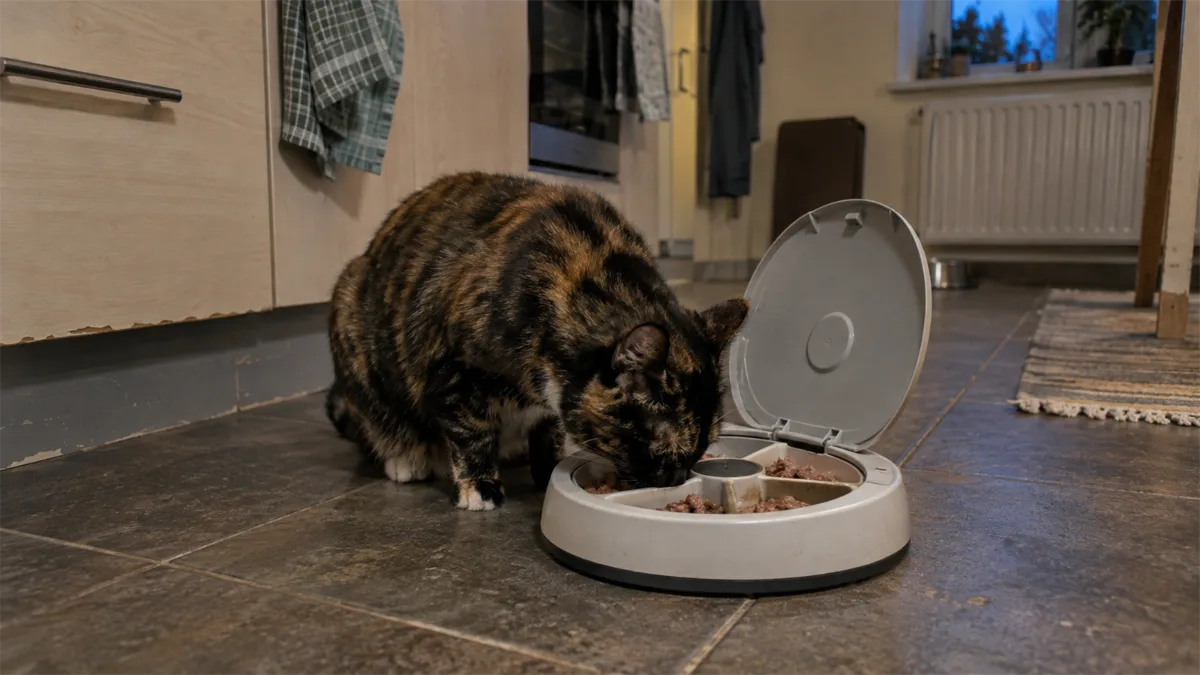
Why Wet (or Canned) Food Needs a Different Feeder
Wet food should not be left at room temperature for extended periods, and warmer conditions shorten the usable window. Follow the food manufacturer’s storage instructions and your veterinarian’s advice rather than relying on a universal time limit. This is why any genuine automatic wet food cat feeder needs sealed compartments and a cooling method appropriate for the planned interval — a dry-food hopper design does not translate directly.
Refrigerated Models: How Much They Actually Buy You
A refrigerated automatic cat feeder does not necessarily function like a full refrigerator. Some models use reusable ice packs, while others use active cooling. Capacity and claimed cooling duration vary substantially, so check the manufacturer’s temperature guidance, setup instructions, and limitations for the exact model. Do not assume that a sealed or cooled compartment keeps food safe indefinitely.
Sealed Trays, Not a Shared Hopper
Because wet food cannot be stored in a shared room-temperature hopper like dry kibble, most wet-food feeders use a rotating tray with separate meal compartments rather than a bulk reservoir. When it is time to feed, the mechanism exposes one compartment while the others remain closed and, where supported, cooled. More meals therefore require more compartments rather than simply a larger bin.
Timed and Programmable Wet Food Feeders
A programmable wet food cat feeder uses the same basic scheduling logic as other programmable feeders — see our timed cat feeder guide — but adds separate compartments and a cooling method where needed. Confirm that the model’s stated cooling method is suitable for your feeding interval and conditions. If you’re planning to rely on one while away, our vacation cat feeder guide covers testing, backup power and human check-ins.
The Cleaning Reality
This is the part that catches people off guard: a wet food cat feeder needs its compartments washed after essentially every use, not just refilled on a schedule. Wet food residue left in a tray attracts bacteria and odor quickly, and unlike a dry hopper you can leave alone for weeks, this is genuinely more hands-on than people expect going in — worth weighing against how much time an automatic feeder is actually meant to save you.
Best Wet Food Cat Feeders

Cat Mate C300 Three-Meal Feeder
Best for: Short-absence timed wet-food feeding.
- three compartments with two timed openings
- reusable ice pack
- wet or dry food
Start with how many prepared meals you need and how cooling works, then choose the exact model. None of these is a bulk wet-food hopper, and a manufacturer cooling claim is not a universal food-safety guarantee.
| Model / version | Meal layout and cooling | Controls / power | Who it suits / limitation |
|---|---|---|---|
| PETLIBRO Polar PLAF109 | Three 200 ml (6.76 oz) servings; active thermoelectric cooling. | App scheduling; 2.4 GHz Wi-Fi; corded power. | Prepared wet meals with app control. PETLIBRO advises against raw food; three servings do not necessarily cover three days. |
| Cat Mate C500, standard tray | Five compartments: one available immediately, four timed; two reusable ice packs. | Local digital timer; 3 AA batteries. | A simpler local schedule without an app. Ice-pack cooling depends on preparation and room conditions; it is not active refrigeration. |
| PetSafe FreshFeed PFD00-18290 | Six pre-portioned meals; active semiconductor refrigeration. | Pet Companion app scheduling; supplied cord and adapter; no required app subscription. | More prepared meal slots. Verify serving size and cooling instructions for the exact listing; confirm portion volume and usable capacity with PetSafe before choosing it for larger meals. |
Sources that determine this choice: Polar PLAF109 specifications and food restrictions, standard C500 timer, ice packs and batteries, and FreshFeed PFD00-18290 features. US-facing specifications checked September 14, 2026. Polar tray materials and regional versions vary; C500 steel inserts are a separate variant/accessory. Confirm the retailer’s model/package rather than transferring specifications between versions. This comparison uses manufacturer documents, not hands-on tests.

PETLIBRO Polar
Active-cooling option for scheduled wet-food meals.

Cat Mate C500
Five-compartment tray with reusable cooling packs.
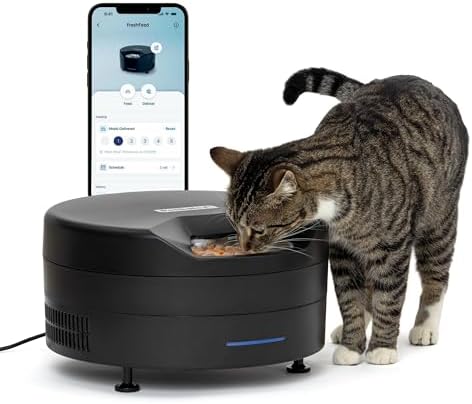
PetSafe FreshFeed
Refrigerated six-meal alternative for fresh or wet food.
For specific models with pricing — including our top refrigerated pick — see the wet-food entries in the full automatic cat feeder guide.
- Refrigerated — what to look for: A compartmentalized feeder with a genuine cooling element (not just an insulated compartment) — look for a manufacturer-stated freshness window rather than assuming “refrigerated” on the box means the same thing across brands.
- Budget — what to look for: A basic multi-dish rotating feeder with reusable ice packs rather than active cooling — suitable only when its stated cooling duration matches your schedule and room conditions.
- Mixed feeding — what to look for: An electric wet food cat feeder that also accepts dry food in a separate compartment, useful if your cat eats a mix rather than wet food exclusively.
As with any best wet food cat feeder list, check the actual number of sealed compartments and the manufacturer’s stated freshness window before buying — those two numbers matter more here than general capacity claims.
Quick Checklist Before You Buy
- Confirm it has genuinely sealed, individual compartments — not a shared bin
- Check whether cooling is active or just an ice pack, and how long freshness is actually rated for
- Match the compartment count to how many days you actually need covered
- Plan on washing it after most uses, not just refilling it
- If your cat eats both wet and dry, check whether one unit handles both or you need two feeders
Decision guide
Rotating tray vs. ice packs vs. active refrigeration
Choose the cooling method around the time you will be away, meal size, and cleaning routine—not the largest meal count.
Rotating tray
- Cooling: none by default
- Time away: short scheduled windows
- Capacity: fixed compartments
- Cleaning: tray and lid
- Best for: measured meals at home
- Limit: no active cooling
Ice-pack tray
- Cooling: reusable packs
- Time away: depends on room conditions and instructions
- Capacity: fixed compartments
- Cleaning: tray, lid, and packs
- Best for: several pre-portioned meals
- Limit: cooling fades
Active refrigeration
- Cooling: powered system
- Time away: follow the model’s stated limits
- Capacity: sealed compartments
- Cleaning: food-contact parts after use
- Best for: wet-food-first routines
- Limit: power and higher cost
Next: compare timed feeders, plan vacation feeding, or compare models.
Frequently Asked Questions
Is canned cat food the same as wet cat food for feeder purposes?
Yes — “canned” and “wet” describe the same category of food, just different common names. Confirm that the exact feeder supports the food texture and serving size you use; canned food is one wet-food format.
How long can wet cat food remain in an automatic feeder?
There is no single safe duration for every food, feeder, and room temperature. Follow the food label and the feeder manufacturer’s cooling instructions, and discard food if its time or temperature history is uncertain.