
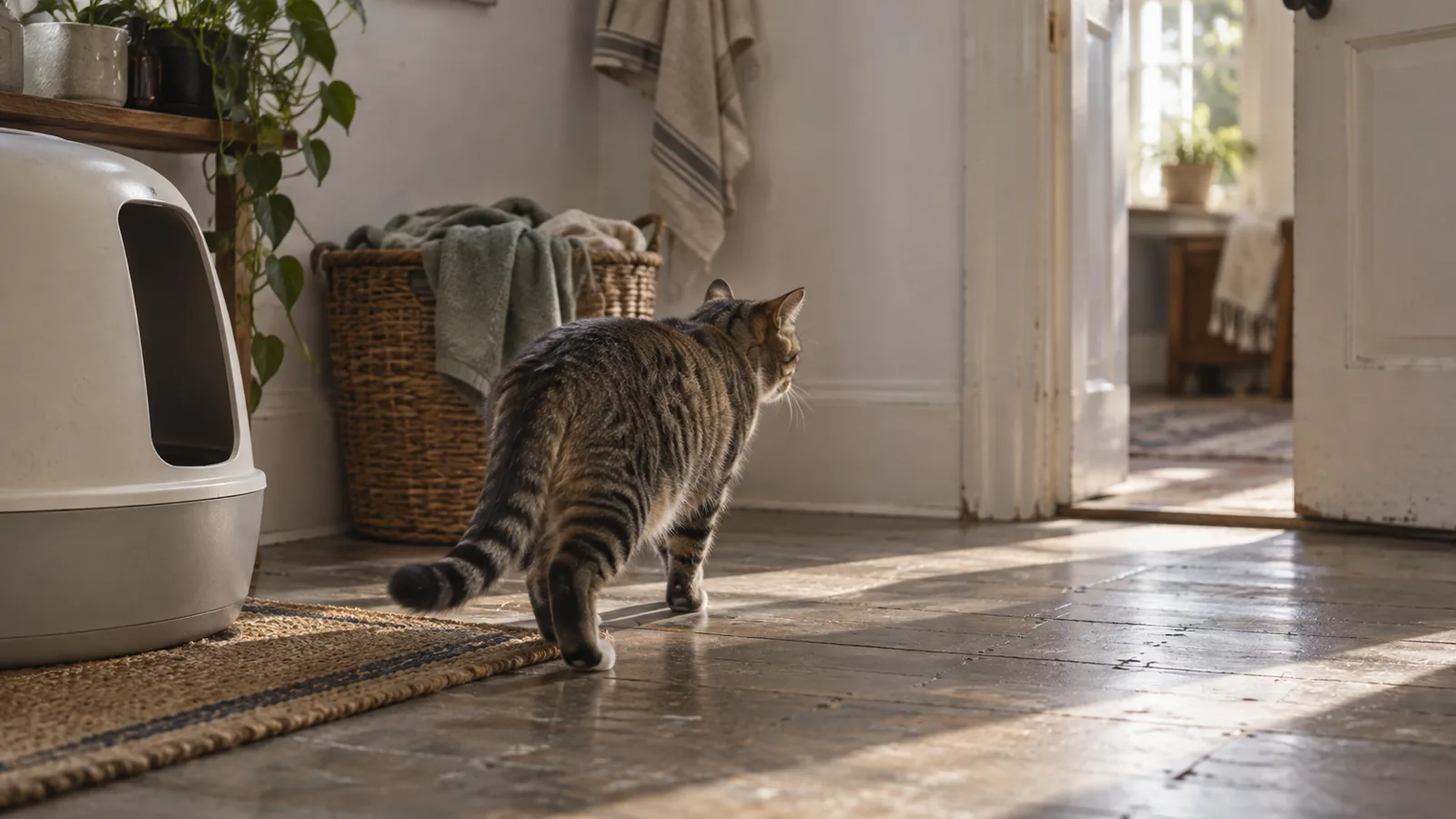
An automatic cat litter box is a sorting machine with a sensor attached. After a cat leaves, the device waits, separates clumps from clean litter, and moves the clumps into a sealed drawer or, in one design, washes reusable granules and sends the waste down a drain. That is the whole product. The marketing adds apps, weight tracking and odor claims, but the decision that matters most is mechanical: which mechanism fits your cats, your litter and your floor space. This guide explains the four designs on the market, how to read a spec sheet, and which documented models we have checked against their manufacturers’ pages. For feeding routines in the same household, our automatic cat feeder guide covers the other half of leaving cats alone for a day.
The Four Self-Cleaning Mechanisms
| Design | How it separates waste | Litter it needs | What to check first |
|---|---|---|---|
| Rotating globe (Litter-Robot, Leo’s Loo Too) | The drum turns, a screen sifts clumps into a drawer below | Clumping clay or other maker-approved clumping litter | Entry size, interior headroom, documented cat weight range |
| Raking tray (PetSafe ScoopFree) | A rake sweeps the tray and pushes solids into a covered compartment | Crystal (silica) litter in disposable trays | Ongoing tray purchases, rake timer, cat size guidance |
| Open-top sifter (Neakasa M1 Plus) | A tilting basin sifts litter through a screen; no enclosed globe | Fast-clumping granular litter | Floor footprint and height, cats that avoid enclosures |
| Water-connected washer (CatGenie A.I.) | Washable granules are scooped, washed, dried; waste goes to a drain | Reusable granules only | A cold-water line, a drain and an outlet in the same spot |
Rotating globes dominate the category because they handle ordinary clumping litter. Their limits are physical: the cat has to fit through the entry and stand inside, and the sensors need the cat’s weight to register. Raking trays are flatter and quieter in principle, but they commit you to crystal litter, usually in disposable trays. Open-top sifters remove the enclosure, which some cats prefer, at the cost of a wider footprint. Water-connected units remove the drawer entirely but turn the purchase into a small plumbing project.
How to Read a Litter Box Spec Sheet
Cat weight range
Every maker publishes a range, and it is not decorative. The lower bound is the weight the sensors need to detect a cat reliably; the upper bound is what the globe or basin is sized for. Whisker lists Litter-Robot 4 for cats 3–25 lb and Litter-Robot 5 for 3–30 lb. Neakasa lists the M1 Plus for 2.2 lb to around 33 lb. Casa Leo lists Leo’s Loo Too for cats up to 20 lb. If a cat sits outside the range, the maker is telling you the device was not designed for that cat.
For a large or long-bodied cat, use our large-cat self-cleaning litter box shortlist before choosing a mechanism.
Entry and headroom
Rotating globes publish an entryway and an interior height. Litter-Robot 4 lists a 15.75″ × 15.75″ entry and 16.5″ interior height; Litter-Robot 5 lists the same entry with 17.5″ of headroom. A long-bodied cat that fits the weight range may still prefer to stand with its head out of the globe, which can affect the sensors’ idea of when the cat has left. The open-top M1 Plus publishes an entry height of 13.86″ instead of an opening size.
Cycle delay
The device waits after the cat leaves so that clumps can form. Whisker lets you set Litter-Robot 4’s delay from 3 to 30 minutes. PetSafe’s ScoopFree support guide says the rake starts a scoop cycle 20 minutes after the cat uses the box. Neakasa publishes no delay figure for the M1 Plus. A longer delay means better clumps and fewer rake or screen smears; a shorter one means less time for a second cat to walk into a dirty box.
Waste capacity, in days
Makers rate the drawer in days for one cat: Whisker says every 8 days for Litter-Robot 4 and every 10 days for Litter-Robot 5; Neakasa says up to 14 days for the M1 Plus’s 11.23 L bin; PetSafe says to change the ScoopFree tray “just once a month” without naming a cat count. Those are one-cat figures. Divide by the number of cats for a rough planning number, and treat it as a ceiling rather than a promise — diet and litter change the result.
Litter restrictions
This is where returns happen. Whisker recommends standard-weight clumping clay and excludes non-clumping, newspaper and wood-pellet litters. Casa Leo says to “use only 100% clay-clumping litter”. PetSafe’s ScoopFree is “designed for use with crystal litter only”. Neakasa’s filter sifts particles up to 3 mm in diameter and 10 mm in length and excludes highly absorbent, non-clumping and pellet litters. If your cats are settled on a litter, start by finding the devices that accept it.
Connectivity
All of the connected models we checked that publish a band specify 2.4 GHz Wi-Fi. Whisker also notes that its robots do not support 5 GHz and cannot join shared networks that need a browser login. If your router merges bands under one name, plan to split them before setup day.
Documented Models by Design
The original cards below are drawn from manufacturer pages checked on October 7, 2026; later additions carry their own check dates. They are not test results; see the methodology page for how BowlScout reads specifications.

Neakasa M1 Plus — Entrance Litter Guard bundle
Open-top self-cleaning litter box. Neakasa states a 2.2 lb to around 33 lb range, a 13.86-inch entry and an 11.23 L waste bin. The Plus revision uses six infrared sensor arrays. This Amazon offer includes the entrance litter guard; confirm the selected bundle and accessories.

Whisker Litter-Robot 4
Best for: Homes with up to four cats in the 3–25 lb range that want weight-based cat identification without cameras.
- Whisker lists it for cats 3–25 lb and “up to 4 cats”
- entryway 15.75″ × 15.75″; interior height 16.5″; footprint 22″ × 27″; 29.5″ tall
- cleaning cycle starts 3 to 30 minutes after use; sealed, carbon-filtered waste drawer; 2.4 GHz Wi-Fi only

PetSafe ScoopFree Crystal Smart
Best for: A raking tray design for households already using crystal litter and disposable trays.
- “Designed for use with crystal litter only”; disposable pre-filled trays that PetSafe says to change “just once a month”
- uncovered unit 27.6″ × 19.1″ × 6.2″ (front-entry version PAL00-16808 is 15.6″ tall); plug-in power
- rake scoops 20 minutes after the cat uses the box (PetSafe support guide); My PetSafe app activity log and tray alerts; LCD health counter
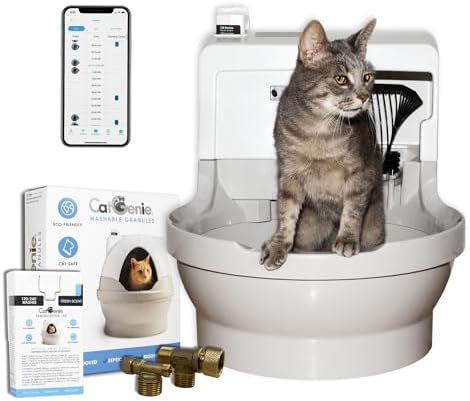
CatGenie A.I.
Best for: Homes with a laundry or bathroom hookup that want washable granules instead of a waste drawer.
- needs “cold water, a laundry drainpipe or toilet, electric, and Wi-Fi” — installed, not just plugged in
- reusable Washable Granules are washed and warm-air dried instead of being thrown away
- 19.25″ wide at the front, 21″ high, 24.5″ deep with hoses; 25 lb assembled; 18-month limited warranty; 90-day money-back guarantee

PetSafe ScoopFree SmartSpin
For: A rotating, sifting design with clumping litter and app controls.
The white PAL00-17985 model uses plug-in power, a 6 L waste drawer and a 2.4 GHz Wi-Fi connection. PetSafe recommends premium clumping litter. It differs from ScoopFree Crystal Smart, which rakes a crystal-litter tray; the litter and consumables are not interchangeable. Check the current manual for cat suitability and placement before buying.
Specification source: manufacturer page. Model and listing checked October 20, 2026; specifications are manufacturer claims, not hands-on test results.

Casa Leo Leo’s Loo Too
The matched Amazon listing is the standalone Leo Gray Leo’s Loo Too, rather than a protection-plan bundle. Compare the manufacturer’s cat-weight and space requirements in the tables above, and check the selected variant before ordering.
Specification source: manufacturer page. Model and listing checked October 20, 2026; specifications are manufacturer claims, not hands-on test results.
Neakasa references on this page now cover M1 Plus. Its exact Amazon offer is the Entrance Litter Guard bundle. Litter-Robot 5 remains an editorial comparison with manufacturer sources; no exact Amazon listing was established, so it has no purchase card. Litter-Robot 4 remains a separate option within its own 3–25 lb range and up-to-four-cat limit.
What the Apps Do, and What They Do Not
Connected litter boxes report cycles, drawer level and, with weight sensors, which cat visited. Whisker’s free app tier shows weight-based cat identification, trended weight and visits, and a 7-day history; longer history is part of its paid Whisker+ membership. PetSafe’s app shows an activity log and tray-change alerts. Neakasa’s app lets you monitor the box and control it remotely.
Several makers describe this data as a way to notice changes in a cat’s habits. That is a manufacturer claim about a convenience feature, not a diagnosis. BowlScout is not a veterinary resource; if you see a change in a cat’s weight or visit frequency, the information goes to your veterinarian, not to an app setting.
Placement and Power
Globes are tall — Litter-Robot 4 and 5 stand 29.5″ and 29.9″ — and they need the drawer to pull out at the front. Measure the spot with the drawer open. Rotating units also need a firm floor; Whisker notes SmartScale weight readings are most accurate on a firm surface rather than carpet, and that Litter-Robot 5 adds an integrated carpet tray while Litter-Robot 4 uses a separate accessory. CatGenie A.I. is a different conversation: it needs cold water, a laundry drainpipe or toilet, electricity and Wi-Fi, so the laundry room or a bathroom is where it goes.
Every model here runs on a wall adapter. None of the documented pages lists a battery backup, so a power cut means a manual scoop.
Quick Checklist Before You Buy
- Every cat falls inside the maker’s documented weight range, including kittens that will grow into it
- The litter you already use appears on the maker’s approved list, or you are willing to switch
- The spot fits the published footprint and height with the drawer pulled out
- You have counted the drawer rating in days per cat, not per box
- Your router can offer a 2.4 GHz network
- For CatGenie A.I.: a cold-water line, a drain and an outlet are within the hose lengths
- You have read the maker’s trial and warranty terms (Whisker and CatGenie publish 90-day trials; Casa Leo 14 days; Neakasa 30-day returns)
Frequently Asked Questions
Do self-cleaning litter boxes work with any litter?
No. Rotating globes and the open-top M1 Plus need clumping litter, and several makers name specific exclusions such as non-clumping, newspaper and wood pellets. PetSafe’s ScoopFree uses crystal litter only. CatGenie uses its own washable granules. Check the manufacturer’s list before buying litter in bulk.
How many cats can one self-cleaning box serve?
Use the maker’s number as the ceiling: Whisker states up to 4 cats for Litter-Robot 4 and up to 5 for Litter-Robot 5. Other makers describe multi-cat use without a number. Capacity in cats and capacity in drawer-days are different limits; the drawer fills faster with every added cat.
Is the app required?
For the models we checked, the box cycles without the app once it is set up, but features such as cat identification, remote cycle starts and drawer alerts need the connection. Longer history on Whisker devices is part of a paid membership.
Are the health-tracking features reliable?
They are manufacturer features that log visits and weight. We quote them as the makers describe them and do not evaluate them medically. Talk to a veterinarian about any change you notice in a cat’s habits.