
Explore by need
Find the right feeder for your setup
Choose a guide based on your dog’s size, food type, feeding routine or the features you actually need.
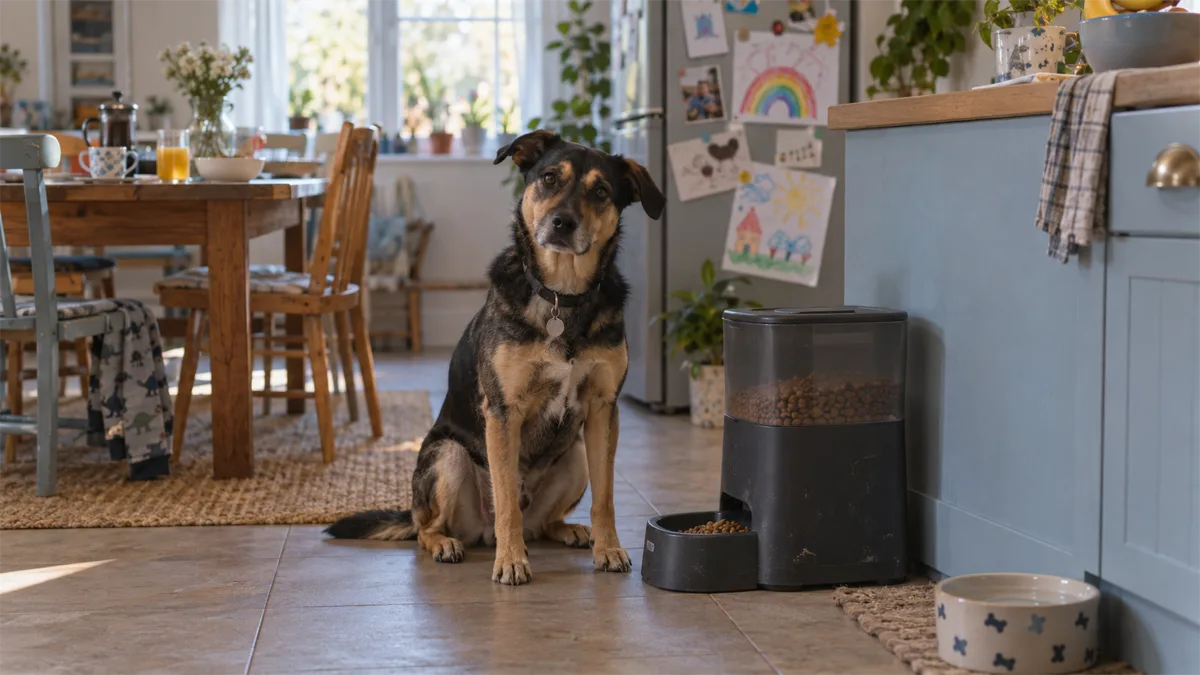
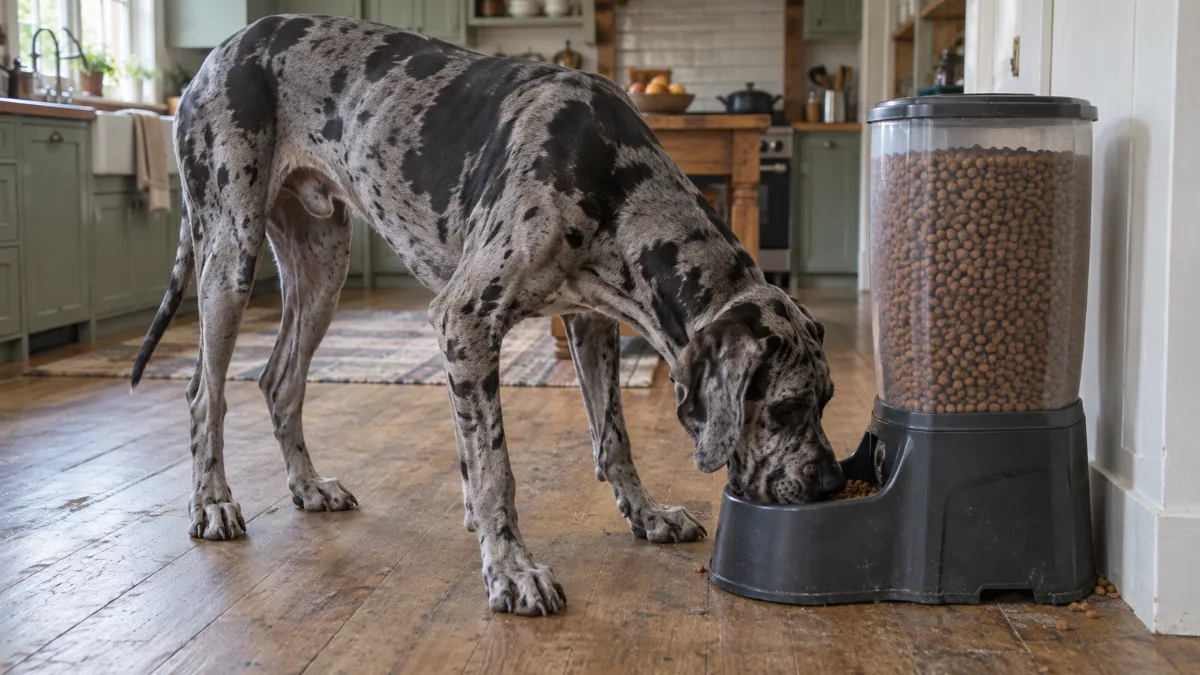 Large dogsHigh-capacity feeders for large dogs
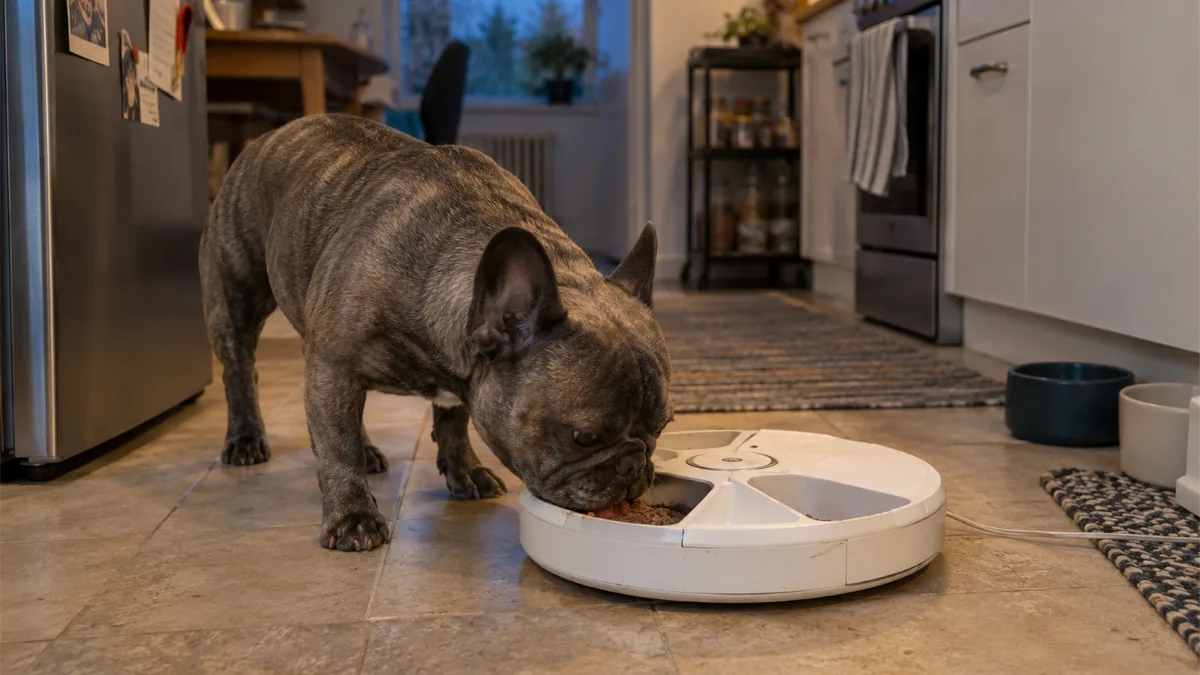 Wet foodAutomatic feeders made for wet food
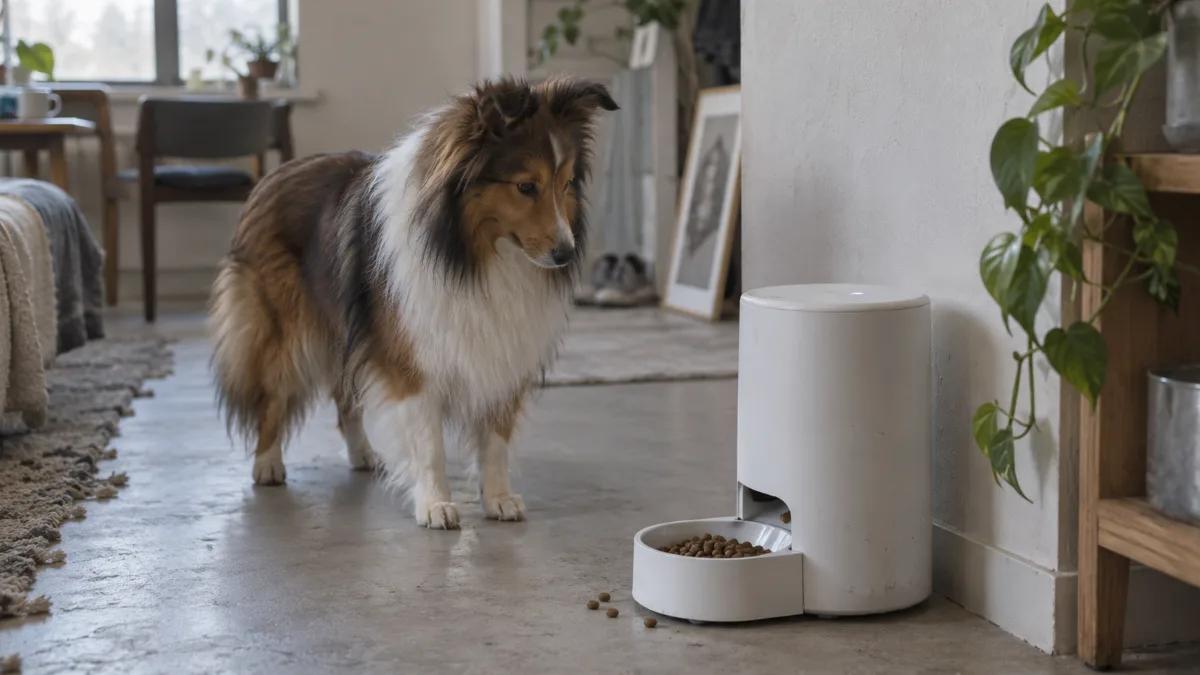 Smart feedingWiFi & app-controlled dog feeders
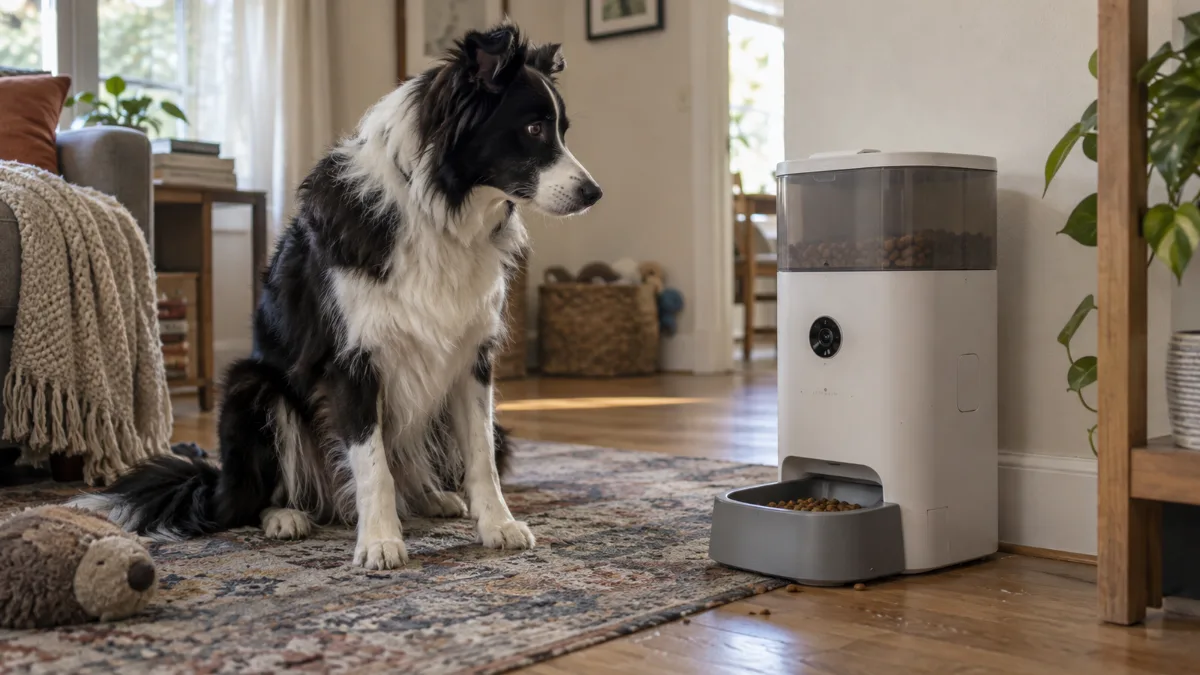 CameraDog feeders with built-in cameras
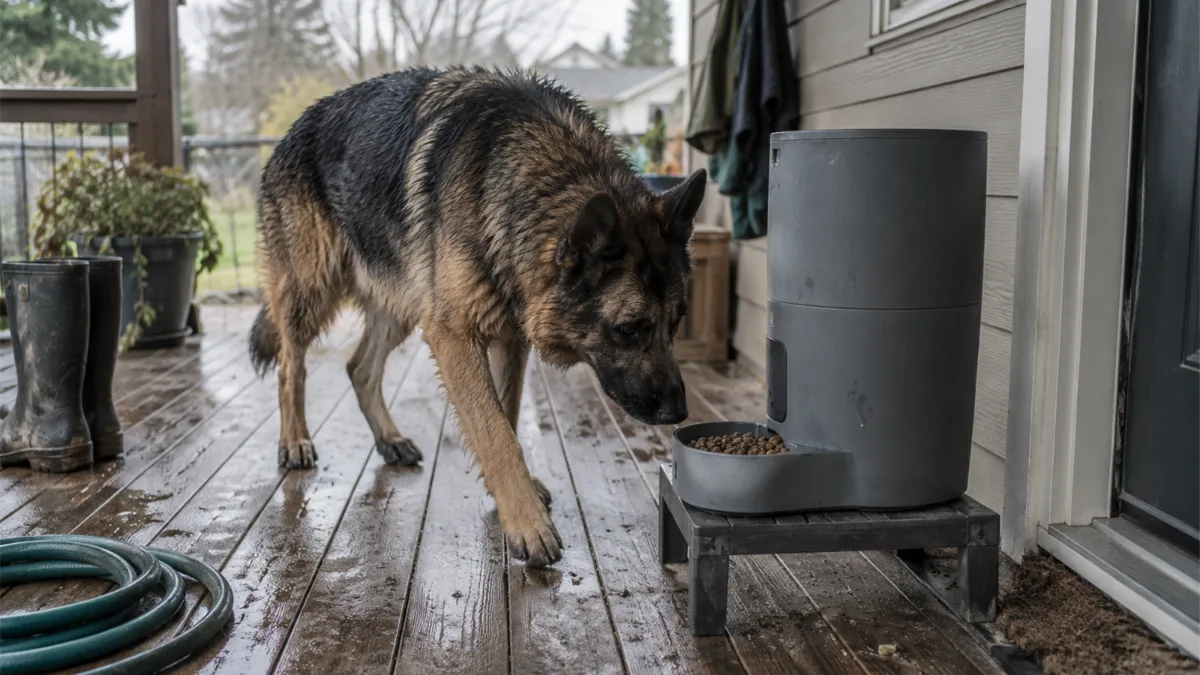 OutdoorOutdoor automatic dog feeders
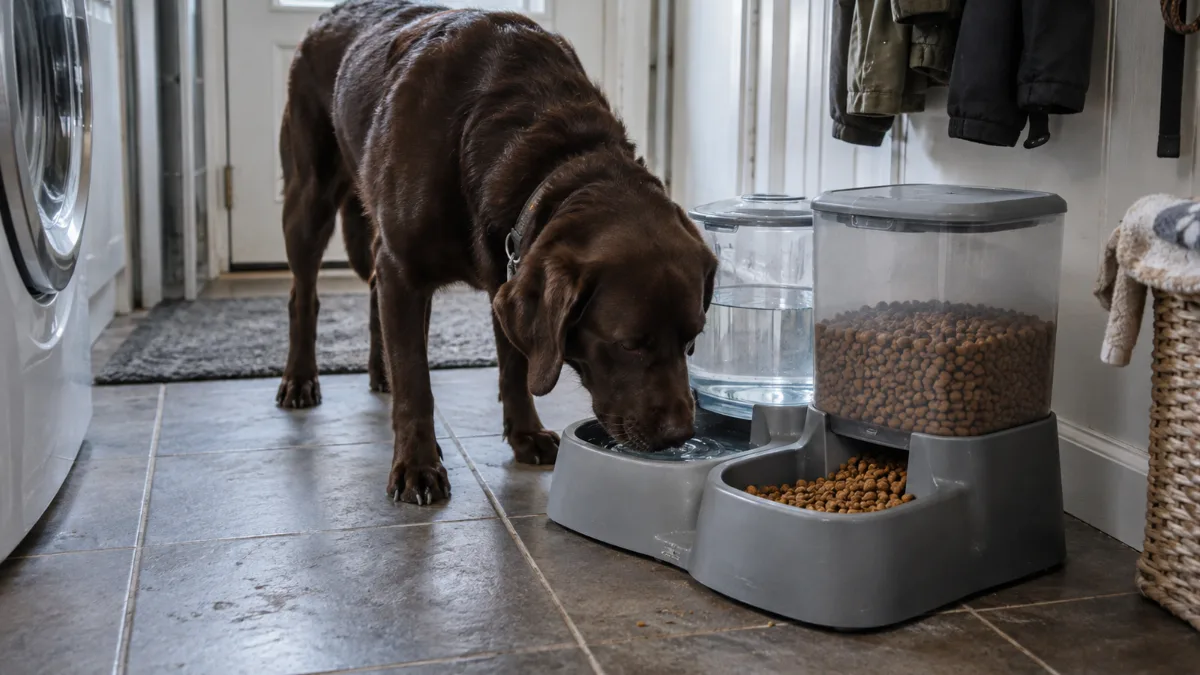 Food + waterCombined feeding & water stations
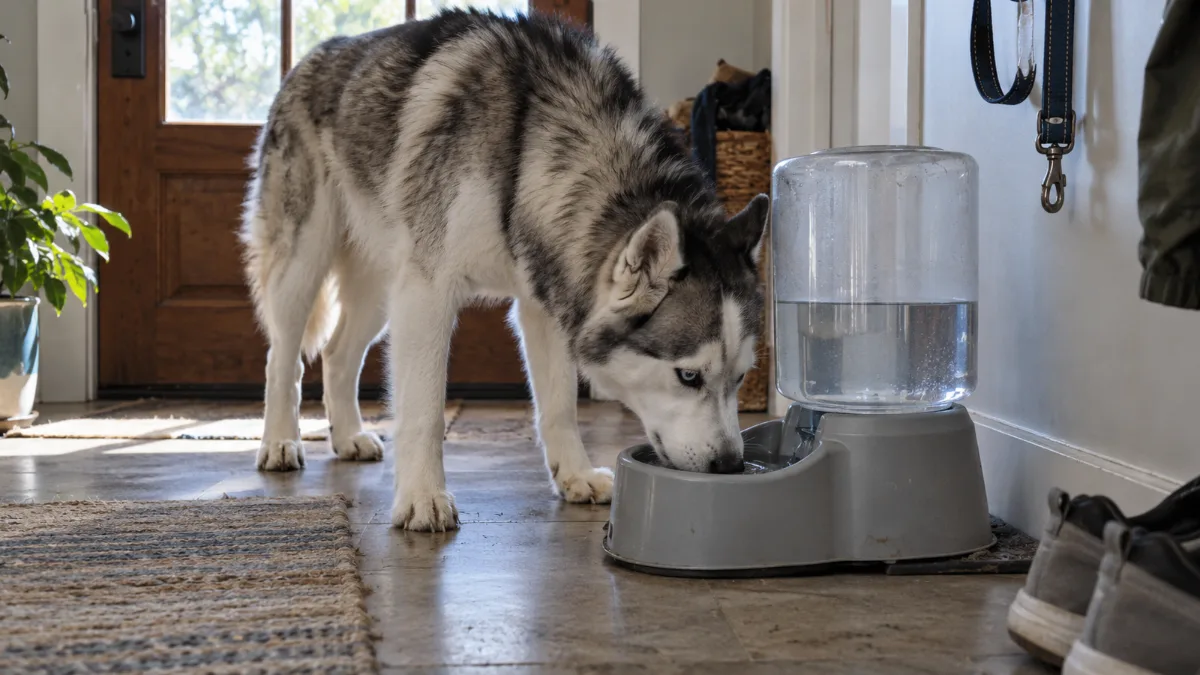 WaterAutomatic water dispensers for dogs
 Timed feedingSimple programmable dog feeders
Keeping track of your dog away from home? Compare GPS and smart collars →
Our top picks
Best automatic dog feeders at a glance
Start with the food and measured meal your dog needs. Use these routes to narrow the choice, then check the limitations.
| Need | Option or next step | Main limitation |
|---|---|---|
| Large dogs | Use the large-dog guide to check kibble size, portions and daily ration. | Hopper capacity alone does not establish suitability. |
| Wet food | Cat Mate C500 offers compartments for wet, dry or mixed meals. | For small dogs; ice packs do not guarantee a fixed safe storage period. |
| App control | Consider PETLIBRO Granary WiFi PLAF103 for app-controlled dry-food scheduling. | Better suited to smaller dogs; check kibble fit and measured portions. |
| Camera | Use the camera-feeder guide after checking bowl, portion and kibble compatibility. | A camera does not establish feeding suitability. |
| Compact placement | Use the comparison tool to shortlist options; no space-saving model is established in this guide. | Feeder dimensions are not provided here, so physical fit remains unverified. |
| Programmable schedule | A basic timer may cover meals at set times without app control. | Check outage behavior; backup batteries may need installing. |
Use the relevant guide for the next check, without treating feature labels as verified fit.
An automatic dog feeder should make feeding more predictable, not more complicated. The right choice depends on your dog’s portion size, kibble shape, food type, refill routine and whether you actually need WiFi, a camera or battery backup.
We organize feeder options and buying criteria by use case. A large hopper or familiar brand does not, by itself, prove that a feeder fits a large dog or a particular kibble size.
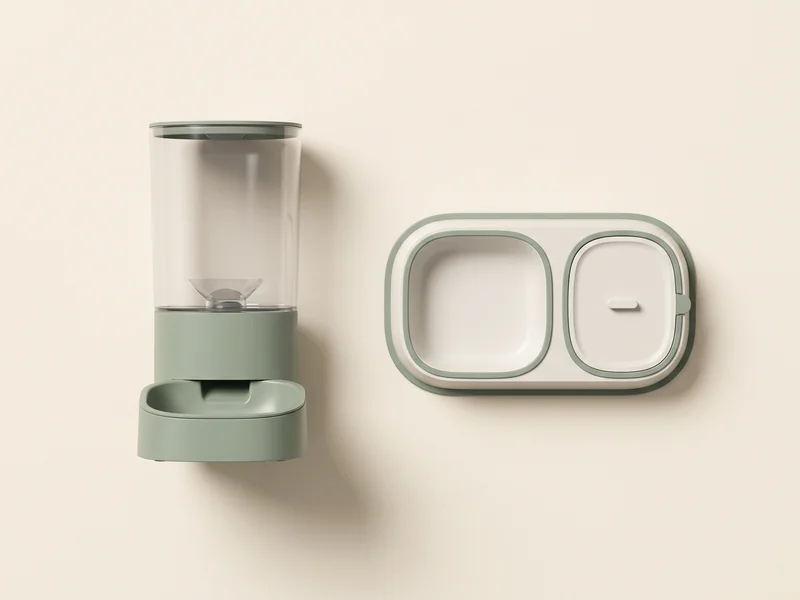
Feeder Options at a Glance
| Feeder | Use case | Capacity | Important limit |
|---|---|---|---|
| Whisker Feeder-Robot | Scheduled dry food for cats or dogs | Up to 32 cups, or 25 with insert | Check 5/8 in kibble limit and per-meal portion |
| PetSafe Healthy Pet Simply Feed PFD00-14574 | Small to medium dogs | 24 cups | Manufacturer does not position it for large dogs |
| PETLIBRO Granary WiFi PLAF103 | WiFi dry-food schedule for smaller dogs | 5 L | Check kibble size and daily ration |
| Cat Mate C500 | Small or toy-dog portions | Five compartments | Check compartment size against each meal |
Smart dry-food option: Whisker Feeder-Robot

Smart dry-food option
Whisker Feeder-Robot
- Optional backup battery can provide up to 24 hours of use in power-saving mode
- Portions as small as 1/8 cup, genuinely fine-grained for a small dog or strict portion plan
- Up to 8 scheduled meals a day with full app control
- Premium price — sits at the top end of this list
- Backup battery is optional rather than included
- Not compatible with wet food
A WiFi-enabled, app-controlled feeder that holds up to 32 cups of dry food, supports up to 8 scheduled meals a day, and dispenses portions in 1/8-cup increments. The optional backup battery is sold separately and can provide up to 24 hours of use in power-saving mode. The larger hopper may reduce refills, but capacity alone does not prove a match for a large dog. Check the per-meal portion range, supported kibble size and your dog’s actual daily intake before estimating how long the food will last. For everything on WiFi vs. Bluetooth vs. basic timers, and what app control actually adds, see our smart dog feeder guide.
Large-dog checklist
Match the feeder to the dog
A large dog can empty a small hopper quickly, but capacity is only one test. Check the manufacturer’s maximum kibble size, the amount delivered per scheduled meal, the number of meals per day and whether the unit resists tipping. The large-dog feeder guide explains those checks in detail.
PetSafe describes its 24-cup Healthy Pet Simply Feed PFD00-14574 for cats and small to medium dogs. Its capacity alone is not evidence that it is the best feeder for a large dog. Check the manufacturer specifications before matching any feeder to a large-breed ration.
WiFi dry-food option: PETLIBRO Granary WiFi PLAF103

WiFi dry-food option
PETLIBRO Granary WiFi PLAF103
- Manufacturer-identified PLAF103 with a 5 L hopper
- Up to 10 scheduled meals and 20 ml portion units
- Power adapter with three D-cell batteries available as backup
- Dry food only; manufacturer specifies 2–15 mm kibble
- PETLIBRO’s guidance better suits small or medium pets than large dogs
- Check your dog’s actual ration against the portion schedule
PETLIBRO identifies Granary WiFi as model PLAF103 and lists a 5 L dry-food hopper, 20 ml portion units and 2–15 mm compatible kibble. The hopper’s volume does not establish a fixed cup count or number of feeding days: measure your dog’s daily ration. If a camera is essential, use our dog feeder with camera guide to compare that feature separately.
Compartment feeder context: PetSafe Eatwell 5-Meal

Compartment feeder context
PetSafe Eatwell 5-Meal
PetSafe describes the five-meal model as suitable for cats and small to medium dogs, with five one-cup compartments for dry or semi-moist food and treats. It is a different format from a dry-kibble hopper. Check the manufacturer specifications and compare each compartment with your dog’s measured meal.
If wet-food feeding is the goal, start with the dedicated wet-food guide. Do not assume a timed tray keeps perishable food safe without suitable cooling and timing.
For Small and Toy Dogs: Cat Mate C500

For Small and Toy Dogs
Cat Mate C500
- Closer Pets identifies the C500 for cats and small dogs
- Five compartments for wet, dry or mixed meals, with twin ice packs included
- Four future meal times can be programmed after the first open compartment
- Cooling time varies with room temperature; the ice packs do not make it a refrigerator
- Compartments must be filled and measured by hand
- Check the bowl size against your dog’s actual meal before relying on it
The manufacturer describes the C500 as a five-compartment feeder for cats and small dogs that can hold wet, dry or mixed food. It includes twin ice packs, but Closer Pets says cooling duration depends on room conditions and advises testing an ice pack where the feeder will sit. Do not assume a fixed safe period for perishable food; our wet-food feeder guide covers the broader timing and cooling questions.
Compact option
PETLIBRO Air Smart PLAF108

PETLIBRO Air Smart PLAF108
Compact 2 L dry-food feeder, black, with 2.4 GHz Wi-Fi and a rechargeable battery. PETLIBRO claims up to 30 days per charge; actual runtime depends on use. Check meal size and kibble compatibility against your dog’s measured ration.
This is a functional alternative to the previously catalogued Dogness Mini, not a successor from the same brand. Its 2 L hopper suits a smaller refill requirement; Wi-Fi and rechargeable power are specific to PLAF108. It is not a confirmed lowest-price pick.
Mid-range checklist
Confirm the exact model first
Start with a named model and check its own specifications. Arf Pets lists the Automatic Dog & Cat Feeder APAUF6L; compare its meal settings and capacity with your dog’s measured portions instead of relying on a generic product title.

Arf Pets 6 L APAUF6L
Programmable dry-food feeder with a 6 L hopper and up to four meals per day. This is the APAUF6L model. Confirm its portion settings against your pet’s measured meal before relying on a schedule.
At a mid-range budget, compare confirmed model codes, meal and portion settings, available power backup and cleaning access. Use the feeder comparison only after the model identity is clear.
High-capacity checklist
Verify the hopper and mechanism
Do not choose a feeder by a large capacity number alone. Confirm the exact model, its measured capacity, supported kibble size, portion range, backup power and cleaning access with the manufacturer.
For a large dog or more than one pet, use the large-dog capacity guide and calculate daily intake before assuming a large hopper covers several days safely.
Camera checklist
Check dog suitability before camera features
A camera helps you observe meals, but it does not establish that a feeder’s bowl size, portion range or kibble path fits your dog. Compare those feeding requirements first, then check video resolution, app reliability, recording costs and power behavior. Our dog feeder with camera guide covers the feature trade-offs.
WOPET presents Heritage View HV10DP as a dual-bowl feeder for two cats. It remains a separate Cat-catalog model, not a Dog recommendation in this guide.
Practical trade-offs
What usually goes wrong with automatic dog feeders
These are the problems worth checking before you rely on a feeder for daily meals or time away from home.
Large or irregular kibble can catch in narrow chutes. Check supported kibble size and the dispensing mechanism.
Some feeders dispense slightly less than programmed over time, so verify real portions when you first set the schedule.
Not every electric feeder keeps feeding without batteries installed. Backup power matters if you depend on scheduled meals.
A loud motor can make a cautious dog avoid the bowl. Mechanical simplicity can be more valuable than extra features.
Scheduling alone does not slow a dog down. Look for a slow-feed dispensing mode if gulping is the actual problem.
Budget guide
How much should you spend on an automatic dog feeder?
Price usually follows the problem being solved: simple scheduling costs less than app control, cameras or more specialized dispensing mechanisms.
Simple timers and rotating trays for predictable meals without WiFi.
App scheduling, larger hoppers, dual power and more flexible portion control.
Cameras, premium mechanisms or specialized large-capacity designs.
Spend for the feature that solves your feeding problem. A camera is not automatically more useful than a jam-resistant chute, better backup power or easier cleaning.
How BowlScout evaluates feeders
Research first, features second
We cross-check manufacturer specifications and documentation, compare current listings, and use recurring patterns in owner feedback to identify practical trade-offs. Recommendations are organized by use case rather than by affiliate payout or feature count.
Frequently Asked Questions
What’s the difference between an automatic dog feeder and an automatic dog food dispenser?
Nothing functional — they’re the same category described two ways. “Dispenser” and “feeder” are used interchangeably across brands and listings, and neither term signals dry vs. wet, smart vs. basic, or any other distinction on its own.
Do I need a smart/WiFi feeder, or is a basic timer enough?
A basic timer handles the core job — food at set times — for most households. WiFi and app control add remote schedule changes and confirmation that a meal actually happened, which matters more if you’re often away or want peace of mind rather than a strict feeding need.
Are automatic dog feeder reviews from brands themselves reliable?
Treat manufacturer claims as a starting point, not the final word — capacity figures, “days of food” estimates, and portion accuracy are worth checking against independent reviews and real owner feedback, since marketing copy and actual day-to-day performance don’t always match on things like dispensing consistency over time.
Can one automatic feeder handle multiple dogs?
Most single-bowl or single-hopper feeders are really built for one dog — multiple dogs sharing one feeder tends to mean the more assertive dog eats first and more. If you have more than one dog, especially different sizes or feeding needs, look for a feeder rated for multi-dog households or plan on separate units placed apart from each other.