
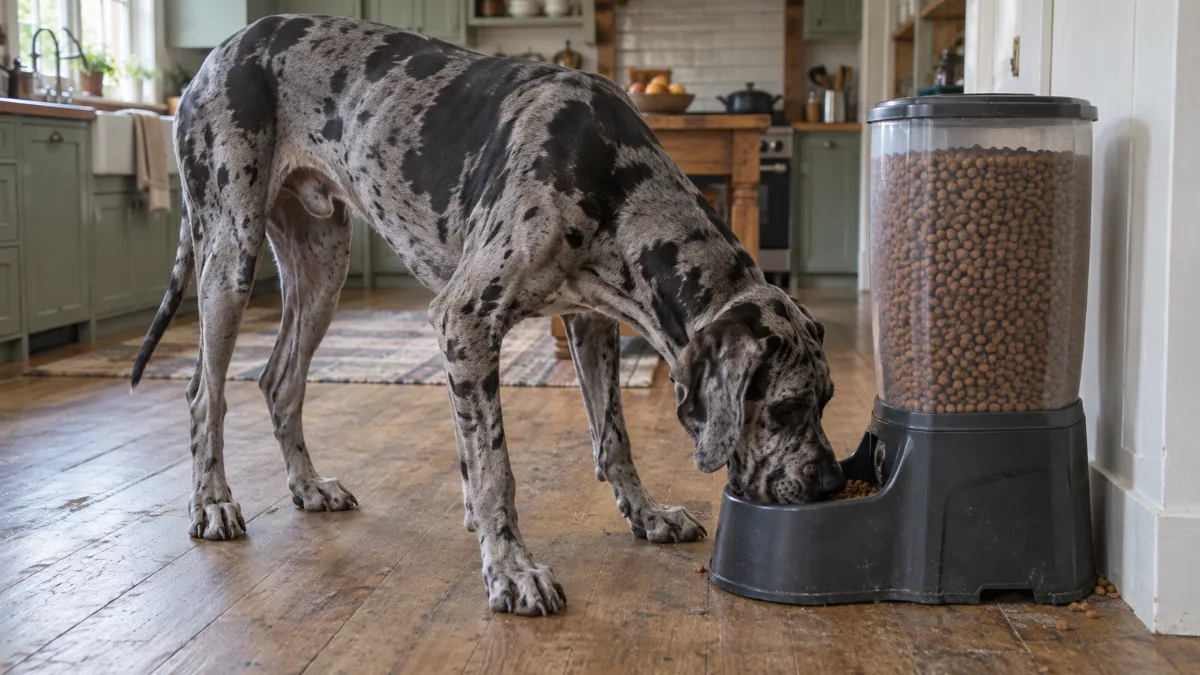
This guide walks through the filters that actually matter for a big dog automatic feeder, rather than treating “large” as one generic checkbox.
Quick picks: automatic feeders to compare
These are specification-based candidates, not hands-on durability tests. Measure your dog’s kibble and weigh one full meal before buying. A large hopper does not guarantee a large enough single dispense or a tip-proof base.
| Model | Hopper | Maximum scheduled meal | Power / backup | Best for / key limit | Shop |
|---|---|---|---|---|---|
| Dokoo FR211 | 15 L | Maximum portion not confirmed | 5V adapter / four D cells | Large kibble up to 22 mm; indoor use | Check price on Amazon (affiliate link, opens in a new tab) |
| WOPET Patrol F07 Pro | 6 L | 50 × about 5 g | Adapter / three D cells | App control; 5–15 mm kibble | Check price at WOPET (affiliate link, opens in a new tab) |
| Whisker Feeder-Robot | 32 cups (25 with insert) | ½ cup | Adapter; backup not stated here | Existing example only; one dispense is too small for many large-dog meals | Check price on Amazon (affiliate link, opens in a new tab) |
Portions measured in grams are not fixed cup amounts: kibble density changes the result. No candidate should be left unattended until you test repeated full-size dispenses and make the feeder stable against your dog’s nudging.
We removed Qpets AF-200, WOPET F01 Plus and FV01 Plus from this purchase shortlist because an exact current retail destination was not established. Dokoo FR211 remains a candidate, but its maximum meal is marked unconfirmed in Fit Lab until conflicting listing figures are resolved. For observation, use a separate Scout camera with a feeder that fits the ration; camera feeders for cats are not automatic large-dog equivalents.
Hopper capacity and your dog’s measured ration
Hopper volume alone cannot tell you how long a supply will last: food density and your dog’s measured ration both matter. Compare capacity with the food label and your dog’s established feeding plan, and confirm the capacity in the manufacturer’s stated units. Do not use a generic daily-cup estimate as a feeding recommendation.
An extra large automatic dog feeder or 25 pound dog feeder is worth the larger footprint if you don’t want to refill weekly — but bigger isn’t automatically better if the mechanism underneath it can’t reliably move that much food (see the next section).
Large kibble compatibility
Kibble compatibility depends on the exact feeder mechanism and food. Check the model’s manual or manufacturer specifications for a stated maximum piece size, then measure your kibble at its widest point. If the manufacturer gives no limit, treat compatibility as unverified. Test the feeder with your own food while supervised before relying on it for scheduled meals.
Feeding Two Dogs or a Kennel
A shared bowl can make it harder to manage each dog’s portion. When dogs need separate rations, compare feeders with separated bowls or use separate units and schedules. For kennel or boarding use, check the manufacturer’s stated duty and service guidance for the exact model; do not assume a consumer feeder is designed for continuous use.
Stability and construction
A dog may bump, lean on or move a feeder, and the risk depends on the individual dog and the specific unit. Check the manufacturer’s guidance for securing and placing the feeder, then observe it in the intended feeding area. Material, a heavy base or a “heavy-duty” label alone does not establish tip resistance, durability or cleaning performance.
Which Automatic Feeders Can Work for Large Dogs?
Judge a candidate against your dog’s measured daily ration, kibble size and feeding schedule. Hopper volume alone does not establish that it can deliver each meal, resist tipping or handle large-breed kibble reliably.
One model to evaluate: Whisker Feeder-Robot
Whisker says Feeder-Robot works for dogs, holds up to 32 cups of dry food without the hopper insert (25 cups with it), and accepts kibble up to 5/8 inch. The standard dispenser releases up to 1/2 cup per scheduled feeding, so check its schedule and your dog’s actual portion before treating it as a match. This is a specification example, not a blanket large-dog recommendation.

Whisker Feeder-Robot
Best for: Scheduled dry-food meals for dogs whose per-meal portion fits its dispenser.
- holds up to 32 cups of dry food without the hopper insert (25 cups with it)
- dispenses up to 1/2 cup per feeding in 1/8-cup steps, 1 to 8 times a day
- accepts dry or semi-moist kibble up to 5/8 inch

Dokoo FR211 15 L
Best for: a large dry-food ration and kibble up to 22 mm, according to Dokoo.
- 15 L hopper; up to six meals daily. Listing text conflicts on the maximum portion count; confirm it in the supplied FR211 manual
- 9 kg body, adjustable raised bowl, vacuum-sealed hopper
- 5V adapter with four D-cell backup; indoor use only
Check first: measure the dog’s kibble and confirm the installed bowl is secure in your feeding area.
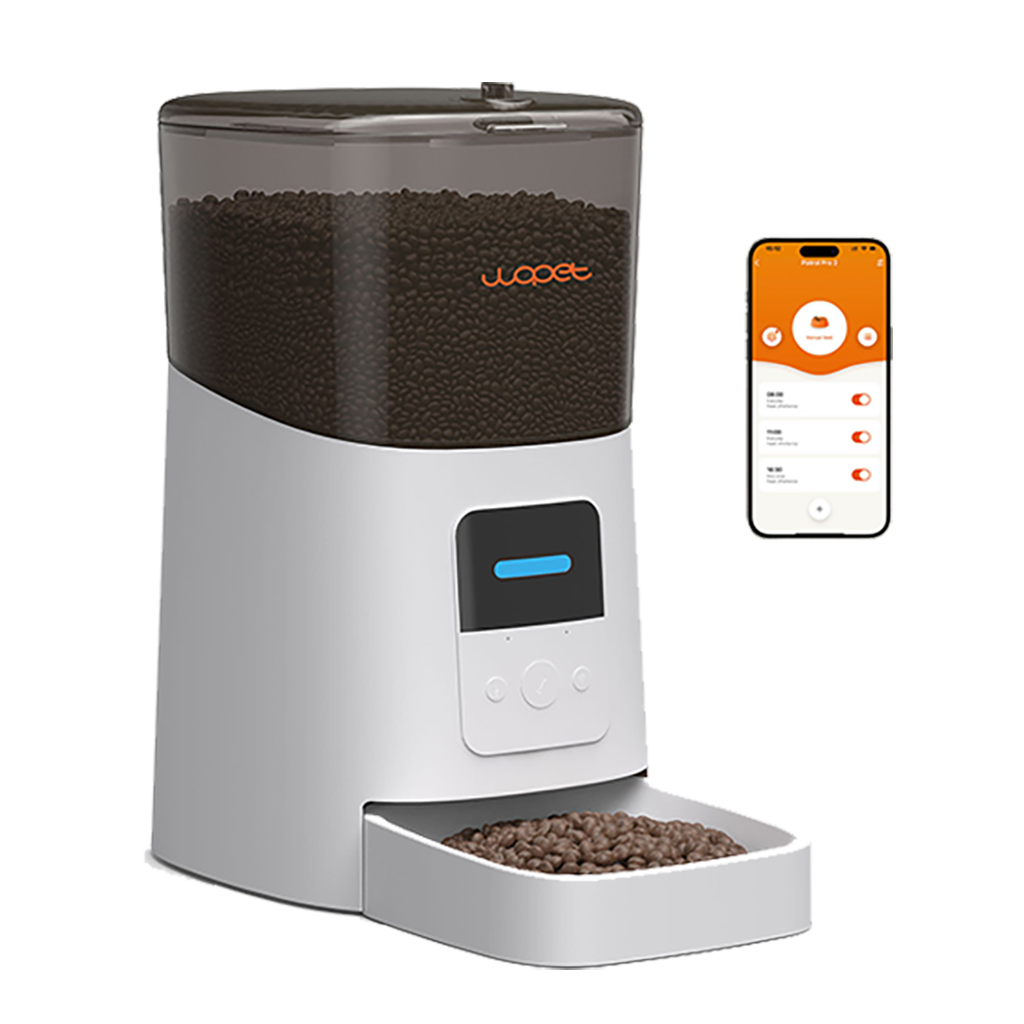
WOPET Patrol F07 Pro
Best for: app scheduling with a 6 L hopper when kibble is no larger than 15 mm.
- Up to 15 meals daily and 50 portions per meal, about 5 g each
- 5–15 mm kibble; lid and food tank safety locks
- Adapter and three D-cell backup; Wi-Fi/app needs adapter power
Check first: weigh the programmed meal and stabilize the feeder where a large dog cannot tip it.
Two previously listed products should not be presented here as large-dog picks on the available manufacturer evidence: PetSafe describes Healthy Pet Simply Feed for cats and small to medium-sized dogs, while WOPET presents Heritage View HV10DP for two cats. Check the manufacturer’s stated pet size and portion range before choosing either for a large dog.
- For kibble compatibility: Check the exact model’s published maximum kibble size and measure your food. If no limit is stated, compatibility is unverified; test with your own food while supervised.
- For stability: Review the manufacturer’s securing and placement guidance for the exact unit, then observe it in your dog’s feeding area. Housing material alone does not establish durability or resistance to tipping.
- For multiple dogs or shared settings: Compare separated bowls or separate schedules when each dog needs its own ration. For kennel use, verify the manufacturer’s duty guidance for the exact model.
As with any best automatic dog feeder for large dogs list, treat this as a starting framework — capacity, kibble-size ratings, and pricing on specific models change often enough to be worth checking current listings before buying. Our dog feeders hub has the full model-by-model comparison.
How to choose for a large dog
Start with the ration, not the hopper label. Use the food calculator as a starting point, then follow the food label and your dog’s established feeding plan. Divide the hopper’s stated capacity by the dog’s actual daily cups to estimate refill frequency; do not treat that estimate as permission to leave a dog unattended for days.
Check kibble and meal compatibility. Measure several pieces at their widest point and compare them with the exact model’s stated limit. For feeders that set portions in grams, run and weigh a test dispense using your own food. Confirm that the unit can deliver the measured meal before relying on its schedule.
Check the feeding station. Look for a secured bowl, a broad or heavy base, and a lid your dog cannot pry open; published anti-tip testing is rare. A removable stainless bowl is convenient to clean, but does not by itself make a feeder tip resistant. Confirm whether batteries actually dispense scheduled meals during an outage or only save settings.
Dry-food hoppers are not a substitute for a wet-food feeder. If remote viewing matters, compare the tradeoffs in our camera feeder guide, then use the comparison tool to narrow the shortlist.
Quick Checklist Before You Buy
- Match hopper capacity to your dog’s daily intake, not just the biggest number available
- Confirm the mechanism is rated for your dog’s actual kibble size, not just labeled “large breed”
- For two dogs or a kennel, get separated bowls or independently scheduled units — not one shared hopper
- Choose steel/heavy-duty construction if your dog is likely to bump, lean on, or chew the unit
- Check for a tip-resistant or weighted base if your dog is large enough to knock it over
Building a larger feeding station? Compare outdoor dog feeder requirements for weather and pest exposure, and review high-capacity water dispensers separately rather than assuming one large unit solves both needs.
Frequently Asked Questions
How can I check whether a feeder handles my dog’s kibble?
Check the exact model’s manual or manufacturer specifications for a maximum kibble size and compare it with your food measured at its widest point. If no limit is stated, compatibility is unverified. Test the feeder with your own food while supervised before relying on its schedule.
Should I choose a gravity or electric feeder?
A gravity feeder does not provide a scheduled portion; an electric feeder may offer scheduling, subject to its published portion and food-compatibility limits. Compare those functions with your dog’s established feeding plan and the manufacturer’s specifications for the exact model.
How much should a large-dog feeder dispense at once?
Use your dog’s measured meal from its established feeding plan, not a breed-based estimate. Check the exact feeder’s per-meal limit, then weigh a test dispense using your actual food.
Will an automatic feeder keep working during a power outage?
Only if that exact model can dispense on battery power. Check the manual for the required batteries and whether the schedule keeps running without wall power. Wi-Fi and live camera features may stop even when scheduled feeding continues.