
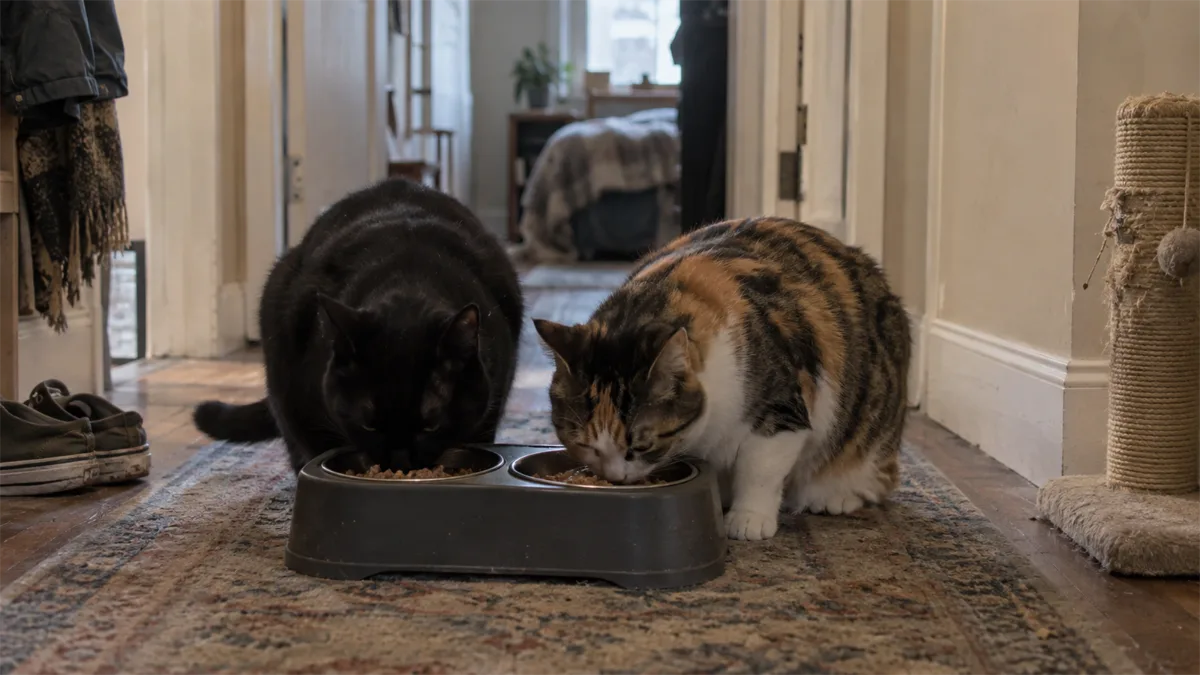
Two Cats, Same Diet → Dual-Bowl
If both cats eat the same food and just need to eat at the same time without competing over one bowl, a dual-bowl automatic feeder is the simplest answer. These typically have two separate bowls spaced apart on one base — real-world products list roughly 11 inches of separation as reasonable for reducing tension at mealtime — with one shared hopper and schedule feeding both sides at once. A 2 bowl automatic cat feeder is not the same as an access-controlled feeder, though: most dual-bowl units don’t have any mechanism to stop one cat from finishing its own bowl and moving to the other, so this solves “eat at the same time” rather than “guarantee each cat gets its own food.” If your cats generally get along and eat similarly sized portions, that’s often enough.
Different Diets or Food Stealing → Access-Controlled Feeding
If your cats eat different food — one on a special diet, one not — or if one cat consistently steals from the other, a dual-bowl feeder doesn’t solve your actual problem, no matter how good the reviews are. What you need instead is a feeder that restricts each bowl to a specific cat, using a microchip reader or an RFID collar tag so the lid only opens for the cat it’s assigned to. This is a real, common issue: cats can be genuinely competitive around food, and one cat pushing another away from a shared resource — or simply eating the food meant for a diet-restricted cat — is a normal behavior pattern in multi-cat households, not a sign something’s wrong with your cats specifically. Staggering feeding times and separating feeding locations helps too, but access-controlled feeders solve it more reliably than positioning alone. See our RFID and chip-controlled feeder guide for how these actually work and how to keep a determined second cat from defeating the lock.
Best Automatic Cat Feeders for Two Cats

oneisall PFD-002 Automatic Cat Feeder for 2 Cats
Best for: Two dry-food bowls without app setup.
- 5 L hopper
- dial control for up to six meals daily

PETLIBRO Granary Dual-Bowl WiFi
Best for: App-controlled dry-food meals for two bowls.
- 5 L hopper
- one to ten scheduled meals daily
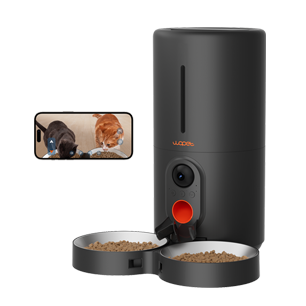
WOPET Heritage View HV10DP
6L smart feeder for two pets with dual bowls, app scheduling and a 1080p camera.

PETLIBRO One RFID
Selective-access option for cats on different diets.

SureFeed Microchip Pet Feeder
Microchip-controlled bowl for reducing food stealing.

PETKIT YumShare Dual-Hopper
Two-hopper camera feeder for households using two dry foods.
- Best dual-bowl for the same diet: A feeder like the Oneisall automatic cat feeder for two cats — dual bowls with real spacing between them, a 5L hopper rated for up to 10 days for two cats, plug-in power with optional battery backup, and up to 6 scheduled meals a day. It’s a shared hopper and schedule for both sides, not independent per-cat control, so it fits the same-diet scenario above rather than the food-stealing one.
✓ Pros
- Real spacing between bowls (~16 inches) genuinely reduces queuing or fighting at mealtime
- 5L/20-cup hopper covers ~10 days for two cats
- 10-second voice recorder calls cats to eat, plug-in power with optional battery backup
✕ Cons
- Shared hopper and schedule — not independent per-cat portion control
- Fits the same-diet scenario only, not food-stealing or different-diet households
- Up to 6 meals/day, precise portion control (~10g/portion) but not app-based on the base model
Price: Check current price
- Best for different diets or food stealing: A microchip or RFID-restricted single-bowl feeder — see our RFID guide for specific picks — used one per cat, or a feeder explicitly built with chip-locked access on each side if you can find one covering both cats in a single unit.
- Best budget option: A basic two-bowl gravity or simple-timer feeder without app control, if all you need is simultaneous same-diet feeding without any smart features.
As with any best automatic cat feeder for 2 cats list, match the pick to which problem you actually have — simultaneous feeding or access control — rather than picking by price or capacity alone.
Decision guide
Shared feeder vs. dual bowl vs. selective feeder
The right setup depends on whether the cats share a diet and whether one cat controls access to the food.
Shared feeder
Works only when both cats can eat the same food, self-regulate, and reach the bowl without conflict. It does not show individual intake.
Dual bowl
Dispenses one schedule into two bowls. It reduces crowding but does not guarantee equal portions or stop bowl switching.
RFID/selective feeder
Best when diets, medication, or food stealing differ. It provides access control, though separate feeding locations may still help.
Related: RFID and microchip feeders, food-and-water setups, the portion calculator, and self-cleaning litter boxes for multiple cats.
Frequently Asked Questions
Can cats share a food bowl?
Physically, yes, but it’s not usually recommended. Sharing a bowl forces close contact during a moment cats can be territorial about, which raises the odds of competition or one cat guarding the food. Separate bowls, even side by side, reduce that tension.
Can cats eat from the same bowl safely?
There’s no direct health risk to sharing a bowl, but behaviorally it can lead to one cat eating faster or more assertively, leaving the other undersupplied — especially between cats that don’t get along or have different food needs.
Why do my cats switch food bowls?
This is usually curiosity, mild competition, or one cat pushing the other off a bowl rather than a food-quality issue. If it happens consistently and one cat seems to be losing out on food, that’s a sign to move toward separated or access-controlled feeding rather than shared bowls.
Is a chip-restricted feeder necessary, or is separating bowls by location enough?
Location separation and staggered timing help and cost nothing, but they rely on your cats generally respecting the boundary. A determined or food-motivated cat will often still find and eat from the other bowl — a chip-restricted feeder removes that possibility rather than just discouraging it.