
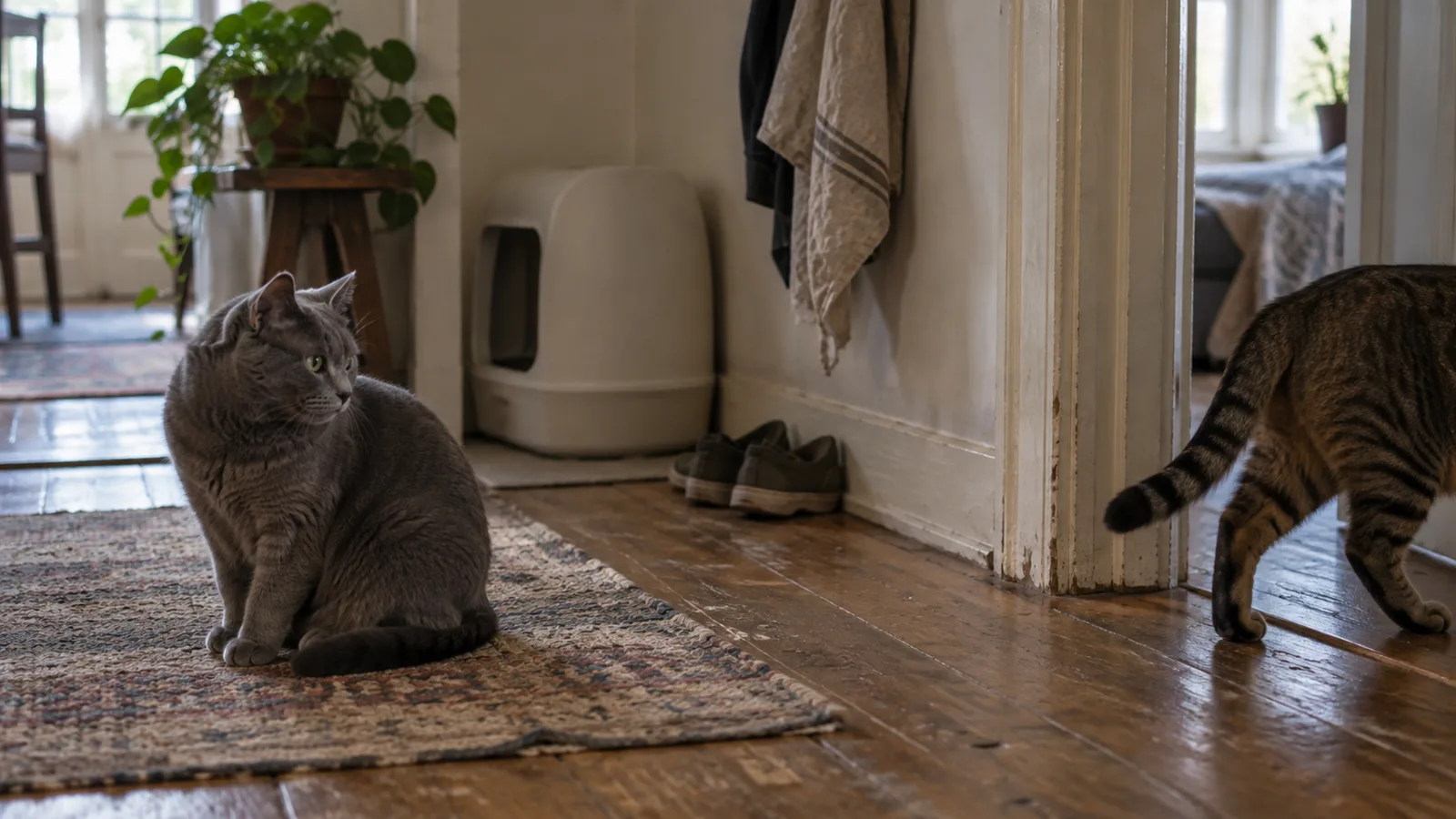
Two cats do not double the work of one cat for a self-cleaning litter box; they change what breaks first. One cat rarely walks into a box mid-cycle. Two cats do. One cat’s drawer lasts the number of days on the spec sheet. Two cats halve it. And the weight range that was easy to satisfy with one adult becomes a test when the household has a 6 lb kitten and a 19 lb Maine Coon. This guide walks through those constraints using only the figures manufacturers publish. If your cats also share an automatic feeder, the same household planning applies in our two-cat feeder guide.
Start With the Weight Range, Not the Cat Count
A device’s weight range has to cover every cat that will use it. The lower bound is what the sensors need to register a visit; the upper bound is what the mechanism is sized for. Here is what the makers in this set state:
| Model | Documented cat weight range | Stated cat count | Source |
|---|---|---|---|
| Whisker Litter-Robot 4 | 3–25 lb | up to 4 cats | litter-robot.com |
| Whisker Litter-Robot 5 | 3–30 lb | up to 5 cats | litter-robot.com |
| Neakasa M1 Plus | 2.2 lb to around 33 lb (kitten mode below 2.2 lb) | “multi-cat” without a number | neakasa.com |
| Casa Leo Leo’s Loo Too | up to 20 lb (9 kg); no minimum stated | not stated | casaleopet.com |
| PetSafe ScoopFree Crystal Smart | not published | “single or multi-cat households” | petsafe.com |
Two things stand out. First, only Whisker commits to a number of cats, and the number rose from 4 to 5 between Litter-Robot 4 and 5 along with the weight ceiling (25 lb to 30 lb). Second, the heaviest cat decides the shortlist faster than anything else: a 28 lb cat is inside only two documented ranges here (Litter-Robot 5 and the open-top Neakasa M1 Plus).
If one of your cats is large, check the weight and entry fit guide for large cats as well as drawer capacity.
Kittens and the Lower Bound
Multi-cat homes often include a kitten. Below the minimum weight, a rotating globe may not detect the cat, which is the reason makers set a floor. Whisker’s floor is 3 lb in automatic mode for Litter-Robot 4 and 5. Neakasa publishes a Kitten Mode for cats under 2.2 lb (1 kg) that prevents automatic cleaning, so the box behaves like a static tray until the kitten grows. The practical rule for a mixed household: until the youngest cat is inside the range, run the device as a manual box or keep a conventional tray alongside it.
Drawer Days Divided by Cats
Makers rate waste capacity for one cat. Dividing by the number of cats is arithmetic, not a manufacturer promise, but it is the only planning number available:
| Model | Maker’s one-cat rating | Two cats (÷2) | Three cats (÷3) |
|---|---|---|---|
| Litter-Robot 4 | “up to 8 days” | about 4 days | about 2–3 days |
| Litter-Robot 5 | “every 10 days” | about 5 days | about 3 days |
| Neakasa M1 Plus (11.23 L bin) | “up to 14 days” | about 7 days | about 4–5 days |
| PetSafe ScoopFree Crystal Smart | tray change “just once a month” (no cat count given) | about 2 weeks | about 10 days |
Casa Leo publishes no figure in days for Leo’s Loo Too (“extra-large, sealed waste drawer” only), so it is left out of the table. The division assumes equal use and the maker’s test litter. Cats on wet food, cats that dig, and lightweight litters all change the outcome. The point is comparative: an 11 L bin buys you about a week with two cats, while an 8-day drawer becomes an every-few-days chore.
Traffic: Who Walks In During the Cycle
With two or more cats, the second visitor matters. Rotating globes use sensors to stop the cycle when a cat approaches. Whisker describes a multi-layer system of lasers, weight sensors and anti-obstruction detection, and lets you choose a delay from 3 to 30 minutes before the cycle starts. Casa Leo lists radar detection, four weight sensors and an anti-pinch sensor. Neakasa uses infrared sensors on an open basin (six sets in the “M1 Plus” revision its page now describes).
A longer delay protects clumps; a shorter delay reduces the chance that cat number two finds a dirty box. In a busy household, a shorter delay with a clumping litter the maker approves is usually the compromise.
Cat Identification by Weight
If you want to know which cat is using the box, weight is how connected models tell them apart. Whisker’s SmartScale assigns visits to cats by weight in both Litter-Robot 4 and 5, with a 7-day history on the free app tier and longer history under its paid Whisker+ membership; the Litter-Robot 5 Pro adds cameras for identification, according to Whisker’s comparison chart. Two cats of nearly the same weight will blur in any weight-based system — the makers do not publish a minimum difference, so treat identification as approximate when cats are within a pound or two of each other.
Makers also present these logs as a way to notice changes in a cat’s routine. We quote that as the manufacturer’s description of the feature. It is not veterinary advice, and a change you notice belongs in a conversation with your veterinarian.
One Box or Two?
The usual guidance that circulates among cat owners is one box per cat plus one. Manufacturers of self-cleaning boxes argue the opposite — Whisker’s pages say Litter-Robot “removes the need for multiple boxes” up to its stated cat count. Both positions are about behaviour, not mechanics. If your cats already share a conventional box without conflict, one self-cleaning unit inside its weight range and cat count is the maker-supported setup. If one cat guards the box or a cat is in the kitten phase below the minimum weight, keep a second, conventional tray during the transition. The device cannot solve guarding; it can only keep the one box clean.
Documented Multi-Cat Candidates
Neakasa references on this page now cover M1 Plus. Its exact Amazon offer is the Entrance Litter Guard bundle. Litter-Robot 5 remains an editorial comparison with manufacturer sources; no exact Amazon listing was established, so it has no purchase card. Litter-Robot 4 remains a separate option within its own 3–25 lb range and up-to-four-cat limit.

Neakasa M1 Plus — Entrance Litter Guard bundle
Open-top self-cleaning litter box. Neakasa states a 2.2 lb to around 33 lb range, a 13.86-inch entry and an 11.23 L waste bin. The Plus revision uses six infrared sensor arrays. This Amazon offer includes the entrance litter guard; confirm the selected bundle and accessories.

Whisker Litter-Robot 4
Best for: Homes with up to four cats in the 3–25 lb range that want weight-based cat identification without cameras.
- Whisker lists it for cats 3–25 lb and “up to 4 cats”
- entryway 15.75″ × 15.75″; interior height 16.5″; footprint 22″ × 27″; 29.5″ tall
- cleaning cycle starts 3 to 30 minutes after use; sealed, carbon-filtered waste drawer; 2.4 GHz Wi-Fi only

PetSafe ScoopFree Crystal Smart
Best for: A raking tray design for households already using crystal litter and disposable trays.
- “Designed for use with crystal litter only”; disposable pre-filled trays that PetSafe says to change “just once a month”
- uncovered unit 27.6″ × 19.1″ × 6.2″ (front-entry version PAL00-16808 is 15.6″ tall); plug-in power
- rake scoops 20 minutes after the cat uses the box (PetSafe support guide); My PetSafe app activity log and tray alerts; LCD health counter

Casa Leo Leo’s Loo Too
The matched Amazon listing is the standalone Leo Gray Leo’s Loo Too, rather than a protection-plan bundle. Compare the manufacturer’s cat-weight and space requirements in the tables above, and check the selected variant before ordering.
Specification source: manufacturer page. Model and listing checked October 20, 2026; specifications are manufacturer claims, not hands-on test results.
To run your own cats’ weights, litter and floor space against every model in this guide, use the litter box fit check.
Space and Noise With More Than One Box
Some multi-cat homes end up with two units. Footprints then matter twice: Litter-Robot 4 and 5 are 22″ × 27″ and about 29.5″–29.9″ tall; Neakasa publishes a 13.86″ entry height and a 22.81 lb empty weight; CatGenie A.I. is 19.25″ wide at the front, 21″ high and 24.5″ deep with hoses. Noise claims are the makers’ own: Casa Leo about 30 dB for Leo’s Loo Too, Neakasa 50 dB or less for the M1 Plus, and Whisker describes QuietSift without a decibel figure. We have not measured any of them.
Quick Checklist Before You Buy
- Your heaviest cat is inside the documented upper weight limit; your lightest is above the minimum (or you will run a kitten mode or a manual box until it is)
- You have divided the maker’s drawer rating by your number of cats and can live with the result
- Every cat uses the same litter, and that litter is on the maker’s approved list
- If a cat avoids enclosed boxes, you have considered an open-top design
- You have a plan for the transition period, including keeping the old box nearby
- If weight-based identification matters to you, your cats differ enough in weight for it to be useful
Frequently Asked Questions
How many cats can use one self-cleaning litter box?
Whisker publishes limits: up to 4 cats for Litter-Robot 4 and up to 5 for Litter-Robot 5, within the documented weight ranges. Other makers describe multi-cat use without a figure. The drawer rating divided by cat count is usually the more limiting number in daily life.
Can two cats use the box at the same time?
No model is designed for that. Rotating globes use sensors to stop the cycle when a cat approaches, the open-top M1 Plus uses infrared sensors to detect a cat, and the second cat waits. If one cat blocks the box for the other, that is a behaviour issue a device will not fix.
What if my cats are different sizes?
Pick a device whose documented range covers both. In this set, the widest published ranges are Litter-Robot 5 (3–30 lb) and Neakasa M1 Plus (2.2 lb to around 33 lb). Casa Leo’s 20 lb ceiling narrows the field for large cats, and PetSafe publishes no range at all for ScoopFree.
Does a self-cleaning box reduce odor in a multi-cat home?
Makers describe sealed drawers, Whisker’s carbon filter, Casa Leo’s UV-C light and, for Litter-Robot 5, WasteID cycling. Those are manufacturer claims about the device; actual odor depends on how often the drawer is emptied, which with more cats is more often.